




Summarize With AI


Canva's dominance is exactly why so many teams are looking elsewhere. When one tool has 265 million users, it stops being a niche choice and starts being the default nobody actually evaluated. That's not a knock on Canva. It just means a lot of teams are using it without checking whether it's still the right fit.
This guide updates the alternatives worth testing in 2026, with real current pricing, a dedicated look at VistaCreate specifically, and honest picks for teams that want AI features and teams that don't.
What are The Best Canva Alternatives in 2026?
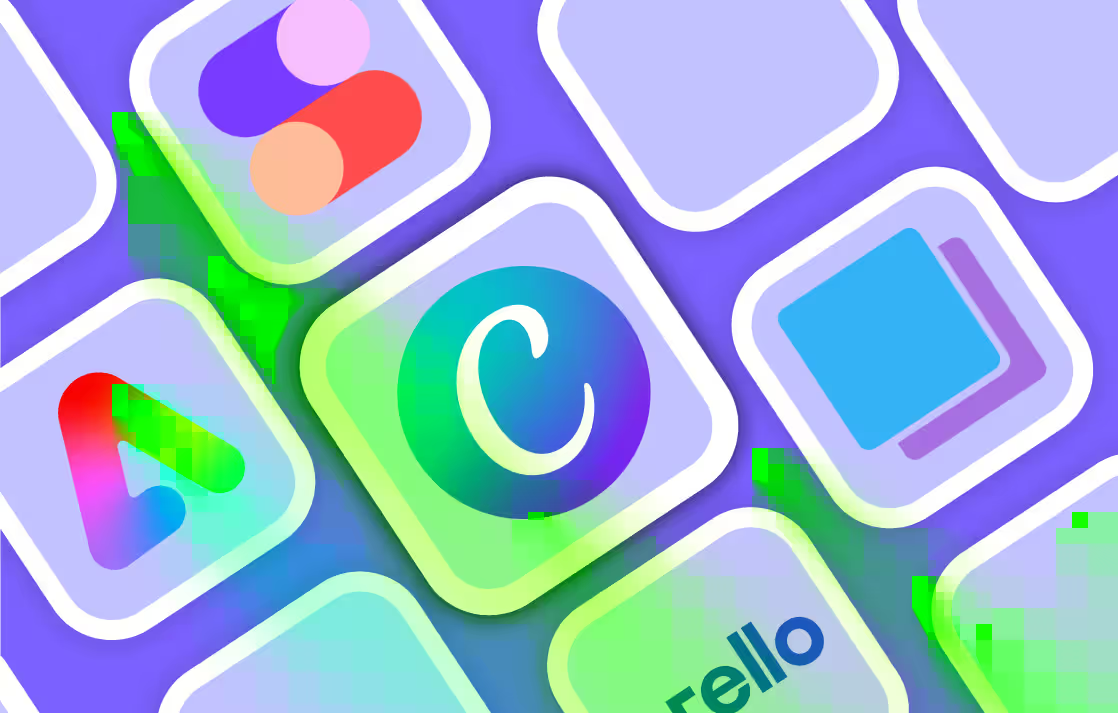
The best Canva alternatives in 2026 are Adobe Express for brand-consistent design work, VistaCreate for a familiar Canva-style interface at a lower price, insMind for AI photo editing on a free plan, Visme for data-heavy visual content, and Stencil for teams that want to skip AI features entirely. Each one solves a different specific complaint about Canva.
- Adobe Express: best if your team already lives inside Adobe's ecosystem or needs tight brand controls.
- VistaCreate: best if you want Canva's drag-and-drop feel without Canva's price.
- insMind: best for product photography and background removal on a genuinely free plan.
- Visme: best for infographics, presentations, and data visualization.
- Stencil: best if avoiding AI features is the actual point.
How Does VistaCreate Compare to Canva?
VistaCreate compares to Canva as a close functional match at a lower price point, with a similar drag-and-drop editor, over 100,000 templates, and more than a million royalty-free stock photos, videos, and vectors on its free tier alone. The main gap is polish. Canva's template library and community integrations still run deeper.
What's a "generative credit"? A generative credit is the unit design tools use to meter AI image or content generation, since each AI-created image costs the vendor real compute. Running out of credits for the month usually means waiting or upgrading, not losing access to the rest of the tool.
VistaCreate's Pro plan costs $10 a month and adds 200,000-plus premium templates, 170 million-plus stock assets, and 100 AI-generated images a month, along with unlimited brand kits and team access for up to 10 members. That undercuts Canva's own Pro pricing while covering most of the same ground.
The honest gap: VistaCreate doesn't try to be everything Canva is. It skips Canva's more advanced video editing and its deeper third-party app marketplace. For straightforward social graphics and marketing assets, most teams won't notice the difference day to day.
What are the Best Free Canva Alternatives With AI Features?
The best free Canva alternatives with AI features are insMind and VistaCreate, both of which give away real AI tools (background removal, image generation, smart cutouts) without gating them behind a paywall on day one. insMind's free starter plan includes its full AI feature set: background removal across 10,000-plus preset backgrounds, an AI smart cutout tool, and an AI image expander for resizing across platforms.
insMind's paid tier costs just $3.99 a month and mainly removes the free plan's logo watermark and unlocks the highest-quality downloads, a genuinely low price for what the free tier already does. VistaCreate's free plan doesn't include AI generation, but its $10 Pro plan adds 100 AI images a month alongside the rest of its design toolkit.
Visme sits a step up from both, aimed at teams that need data-heavy visuals rather than social graphics. Its free Basic plan allows unlimited projects with limited templates, while Starter at $12.25 a month unlocks the full template library and JPG, PNG, and PDF exports. Pro at $24.75 a month adds brand kits, analytics, and video and GIF downloads, useful once a team is producing more than static images.
Are there good Canva Alternatives Without AI?
Yes. Stencil is one of the few mainstream Canva alternatives that hasn't layered generative AI into its core product, which matters if your team specifically wants a design tool without AI-generated content mixed into the results. Its free plan covers 10 collections and 10 monthly Instagram shares, with Pro at $15 a month and Unlimited at $20 a month for full template and photo access.
Stencil's pitch has stayed the same for years: a focused tool for social graphics, not a platform trying to do everything. If your team's complaint about Canva is "too many features I don't use," rather than price or AI specifically, Stencil solves that more directly than switching to another all-in-one platform.
The tradeoff is real. Stencil doesn't do video, presentations, or the AI photo editing insMind offers for free. It does one thing (social graphics) and does it without the extra layer most competitors have added.
Who is Canva's Biggest Competitor for Design Teams?
Adobe Express is Canva's biggest named competitor in current search results, backed by Adobe's existing Creative Cloud user base and its Firefly AI models. Adobe Express Free covers 100,000-plus templates and 1 million-plus Adobe Stock assets, while Premium at $9.99 a month adds 250 generative credits monthly and 200 million-plus stock assets.
Adobe's Firefly Pro tier, at $19.99 a month, goes further: 4,000 monthly generative credits, text-to-video generation, and full access to Photoshop on web and mobile. Teams pricing runs $4.99 to $7.99 a month per license for a minimum of two seats, with pooled storage and brand management tools.
Adobe's advantage isn't features alone. It's the ecosystem. A team already paying for Photoshop or Illustrator gets Express access folded into decisions it's already making, which Canva can't match without its own separate subscription.
Teams weighing several SaaS subscriptions at once often run into this same tradeoff elsewhere. Our piece on Zapier alternatives covers a similar pattern: the incumbent isn't always wrong, but its ecosystem lock-in is worth pricing out honestly before you commit.
How do you Pick the Right Canva Alternative for your Team?
You pick the right Canva alternative by naming the specific complaint driving the search (price, AI features, or unused complexity) and testing the one or two tools built around fixing that complaint, rather than trialing five platforms at once. Most teams already know what's actually bothering them before they start looking.
- Name the real complaint. "Canva costs too much" and "Canva has too many features" point to different tools entirely.
- Check what's actually free. insMind's free AI tools and VistaCreate's free template library both cover more ground than most people expect before paying anything.
- Test with a real project, not a demo. Import an actual campaign asset and see how many clicks it takes to finish it.
- Decide on AI intentionally. If avoiding AI matters to your team, Stencil is the clearest option; if AI is the draw, insMind's free tier or Adobe's Firefly credits are worth comparing directly.
Our related guide on how to choose the right productivity tool walks through this same decision process at a broader level, useful if design software is just one piece of a larger tool audit. Our piece on building a modern work tech stack covers where design tools fit alongside the rest of what a team actually runs day to day.
Curious what your team's actual design tool usage looks like right now? Start a free trial to see real application usage patterns this week, or book a demo to walk through it with us directly.
Is there anything better than Canva? +−
"Better" depends on your complaint. Adobe Express wins on brand consistency, VistaCreate wins on price for similar functionality, insMind wins on free AI photo editing, and Stencil wins if you specifically want to avoid AI features. None beats Canva at everything.
Who is Canva's biggest competitor? +−
Adobe Express, based on current search results and Adobe's existing Creative Cloud user base. It competes directly on templates, stock assets, and AI generation through Adobe's Firefly models, backed by a company many design teams already pay for other tools.
What's a good free Canva alternative? +−
insMind offers its full AI feature set (background removal, smart cutouts, image expansion) for free, and VistaCreate's free tier includes over 100,000 templates and a million-plus stock assets. Both cover real ground before you'd need to pay anything.
How does VistaCreate compare to Canva on price? +−
VistaCreate's Pro plan costs $10 a month versus Canva's higher-priced tiers, while still including 200,000-plus premium templates, 100 monthly AI images, and team access for up to 10 members. It's a close functional match at a lower cost.
Is there a Canva alternative without AI features? +−
Yes. Stencil is one of the few mainstream design tools that hasn't added generative AI to its core product, making it a straightforward pick for teams that specifically want to avoid AI-generated content in their design workflow.
Related Posts

Explore the 12 best automation tools for teams in 2026, from open-source platforms to AI-powered workflow builders. Compare pricing, features, and use cases to find the right automation tool for your team.
Writing performance appraisal comments can be difficult, especially when you want to be honest without sounding too harsh. This guide explains how to write clear and useful feedback, highlight an employee’s strengths, mention areas for improvement, and share practical examples that managers can use during performance reviews.
Looking to reduce business expenses without hurting productivity? Explore 10 practical cost-saving initiatives for the workplace in 2026. From managing resources and reducing unnecessary spending to improving workflows, technology use, and workforce efficiency, these strategies can help businesses control costs, simplify operations, and build a more financially sustainable workplace.

Learn how businesses can detect employee moonlighting through workforce analytics while protecting productivity, security, and employee trust. Explore real-world examples, India's legal position, and practical approaches to identifying undisclosed side work.