



Summarize With AI


As we step into 2026, productivity has taken on a whole new meaning in a world shaped by AI, hybrid work models, and fast-paced digital transformation. Professionals today are expected to deliver high-quality results while managing remote collaboration, constant connectivity, and growing performance expectations. Whether you are an employee, manager, or entrepreneur, mastering smart productivity strategies is essential to stay competitive, reduce burnout, and achieve long-term success. This guide explores practical productivity hacks, modern work techniques, and AI-powered tools to help you work smarter not longer in today’s evolving workplace.
There is no crash course, but here's the good news. You don't need more hours to work on your success but work on the right strategies to make it alright. Whether you're juggling work projects or balancing your personal life, the right productivity hacks can be a game changer,
In this blog, we have listed a few things that will help you write in a diary to work out things smartly. Simple adjustments can bring a massive change in the working methodology! So, let's get started and make it an extraordinary 2025 year ahead.
What Does Productivity Mean To You, And Why Is It Important?
Let us break you a bubble. Productivity is not about ticking off the to-do list; it is about meaningful outcomes of how much time you have worked. Different people have their definitions of productivity.
- For working professionals or employees, it is more about submitting tasks on time and with quality work.
- For a higher authority or a manager, it is more about delegating the proper workflow and smoothly handling the employees' working system.
- For the CEO/Founder/Entrepreneur, it is more about keeping an eye on 360-degree work management from employees to incoming finance.
Simply put, productivity is completing work with quality at the right time, but why do we focus so much on it? Why is it so important?
- It helps maximize the efforts to complete the priority task smartly.
- Helps in improving focus on completing tasks rather than distraction
- Reduces and avoids the stress for last minute work rush
- Boosts efficiency and efforts for the work and optimizes the whole work process smartly
- Supports work-life balance
- Drives towards making informed decisions and future grasping opportunities
- Overall improvement in output quality
Defining what productivity means to you is essential before you dive into strategies. Ask yourself:
- What are my top priorities for 2025?
- What would make me feel accomplished at the end of each day?
- What distractions or inefficiencies are holding me back right now?
Once you have clarity, the following hacks can help you achieve those goals with greater ease and focus.
Top 15 Productivity Hacks to Know Before Entering 2025
Your wait is finally over to jump on the top hacks we have shortlisted so you can move towards 2025 without thinking much and wasting time. Let's break down these hacks with actionable steps and examples to make them easy to implement:
Prioritize with the 80/20 Rule
The 80/20 Rule, known as the Pareto Principle, states that 80% of results come from 20% of efforts. Identify your "20%" activities that drive the most value, and focus your time there.
Example: If you're in sales, 20% of your clients might generate 80% of your revenue. Prioritize nurturing those relationships instead of spreading yourself for the clients you already know will not bring sales.
Time Block Your Schedule
Juggling between multiple tasks will ultimately not help you accomplish any functions. It is important to assign specific time slots for the particular task only. Stay calm and be a multi-tasker; it won't help here. The right time slot allotted will help eliminate guesswork, keeping you on track.
Example: Dedicate 9–11 AM for deep work, like drafting a report, and 3–4 PM for administrative tasks, like answering emails. Stick to the schedule to maintain focus. This can be customized according to your working type and schedule.
Leverage the Power of Morning Routines
A structured morning routine helps you start the day with energy and intention. Instead of scrolling mobile phones, delegate that time for yourself for a better and healthier mindset towards your day ahead.
Example: Begin your day with a 10-minute meditation to clear your mind, then review your top three priorities. This sets the tone for proactive rather than reactive productivity.
Batch Similar Tasks Together
Switching between unrelated tasks drains mental energy. By grouping similar activities, you work more efficiently and smoothly. Imagine if you are served desserts and a main course together. I am sure you love both of them, but you'll only be able to enjoy them if you can consume them individually.
Example: Respond to all emails during a dedicated time block instead of checking them sporadically throughout the day. Similarly, group meetings should be held together to keep your focus intact.
Automate Repetitive Tasks
Time is ahead of us, and we have the tools to solve almost every problem. We have repetitive tasks in our work schedules daily, delegating them to tools. Repetitive tasks consume a lot of time, draining more energy. Tools like We360.ai are here to boost your team's productivity.
It is noted that 78% of workers who automate their routine tasks boost their productivity by 3.3 hours weekly, by saving a lot of time to focus on other important tasks.
Example: Automate time tracking to monitor project progress without manual input, freeing time for strategic decision-making.
Declutter Your Digital and Physical WorkSpace
Decluttering and a clean workspace are very underrated. Not only should your workspace be clean, but your digital space should also be. Clean up files, folders, and data that are no longer needed. This will always help you have a clear mindset without confusing you.
Example: Use folders and naming conventions to organize files. Unsubscribe from unnecessary email newsletters, and keep only essential tabs open during work sessions. Clean your workspace daily and keep only what is necessary on your desk.
Practice the Two-Minute Rule
Multiple tasks are lined up for the whole day, but some take less than 2 minutes or much less time than others. The Two-Minute Rule is simple: if a task takes less than two minutes, do it immediately. This prevents small tasks from piling up.
Example: Instead of flagging a short email for later, respond immediately. Need to schedule a meeting? Set the date as soon as it's discussed. This will prevent further piling up of tasks.
Set Clear Boundaries with Your Devices
Mobile phones and reel addiction are a real thing, a significant distraction for sure. Constant notifications and endless scrolling can derail focus. Manage your tech use intentionally and only when needed.
Example: Turn off non-essential app notifications, set your phone to "Do Not Disturb" during work hours, and schedule social media time instead of using it impulsively.
Incorporate Regular Breaks
If you think taking breaks is counterproductive, then you are wrong here. Breaks help to refresh and recharge your mind. The Pomodoro technique is one of the popular approaches. It is nothing but helps accomplish tasks by taking the required intervals. It helps boost productivity and ultimately complete goals.
59% of employees report that taking breaks improves their work happiness due to which working productivity increases automatically.
Example: Work in 25-minute focused sprints followed by a 5-minute break. After four sprints, take a more extended 15-30 minute break.
Invest in Your Workspace
Your environment impacts your ability to concentrate. Optimize it for productivity. Why do we have an office? The overall setup and working environment help boost motivation to work. Thus, investing in a good setup is a must and always worth it.
Example: Use an ergonomic chair for comfort, set up good lighting to reduce eye strain, and keep your desk free of unnecessary items.
Learn to Say No
There is never a wrong time to say NO. Say NO whenever required, and you think that's an inappropriate request. Saying "yes" to every request dilutes your focus. Learn to decline tasks that don't align with your goals.
Example: If someone asks you to join a meeting that isn't directly relevant, politely explain and suggest sharing the summary instead.
Review and Reflect on Weekly
Regularly reviewing your week helps identify what's working and what's not. Review your work, track the improvement, and focus on things that need rework. Ensure that your to-do list on weekends reflects your tasks and they are mostly ticked off.
Example: Spend 10 minutes on Friday listing three things you accomplished, one you struggled with, and one adjustment you'll make for the next week.
Fuel Your Body and Mind
Consuming healthy food and a healthy routine should not be underrated but something to always stick to. Good nutrition, hydration, and exercise are foundational for productivity.
Example: Keep a water bottle at your desk, snack on nuts or fruit instead of junk food, and squeeze in a 20-minute walk during lunch.
Celebrate Small Wins
Recognizing your progress keeps you motivated and focused on the bigger picture. Write about your wins, no matter how small or big.
Example: Finished a challenging report? Treat yourself to your favorite coffee or take a break to enjoy a hobby.
Stay Flexible
Even the best plans face disruptions. Build buffers into your schedule and maintain an adaptable mindset.
Example: Allocate 30 minutes at the end of the day as "catch-up time" for unexpected delays, or have a list of low-priority tasks ready when the focus is difficult.
Role Of AI In Productivity In The Workplace
By now, we are very much aware of how AI is transforming our work patterns. It is surely here to stay and rule. AI plays a major role in handling repetitive tasks and making sure that they are done error-free.
We360.ai leverages AI to empower organizations to optimize operations with accurate features serving broad industries.
- Automating Workflow Tracking
- Boosting Employee Engagement
- Improving Decision-Making
- Enhancing Remote and Hybrid Work Models
- Customizing Productivity Solutions
Every organization consists of an HR and they have multiple things to look after. It has been noted that almost 38% of the HR and staffing industry takes the help of AI in their practices and routine workflow which helps them to have an accurate report on the working of remote teams and more.
How Does We.360.Ai Will Help In Boosting Productivity?
We.360.ai is not just a tool to use but your productivity partner. It is developed to empower your teams and each authority as it helps to pave the path for productivity by designing smooth workflow, tracking overall performance, and finding the best ways to work smarter.
Let's have a quick look at how We360.ai will help you take productivity to the next level;
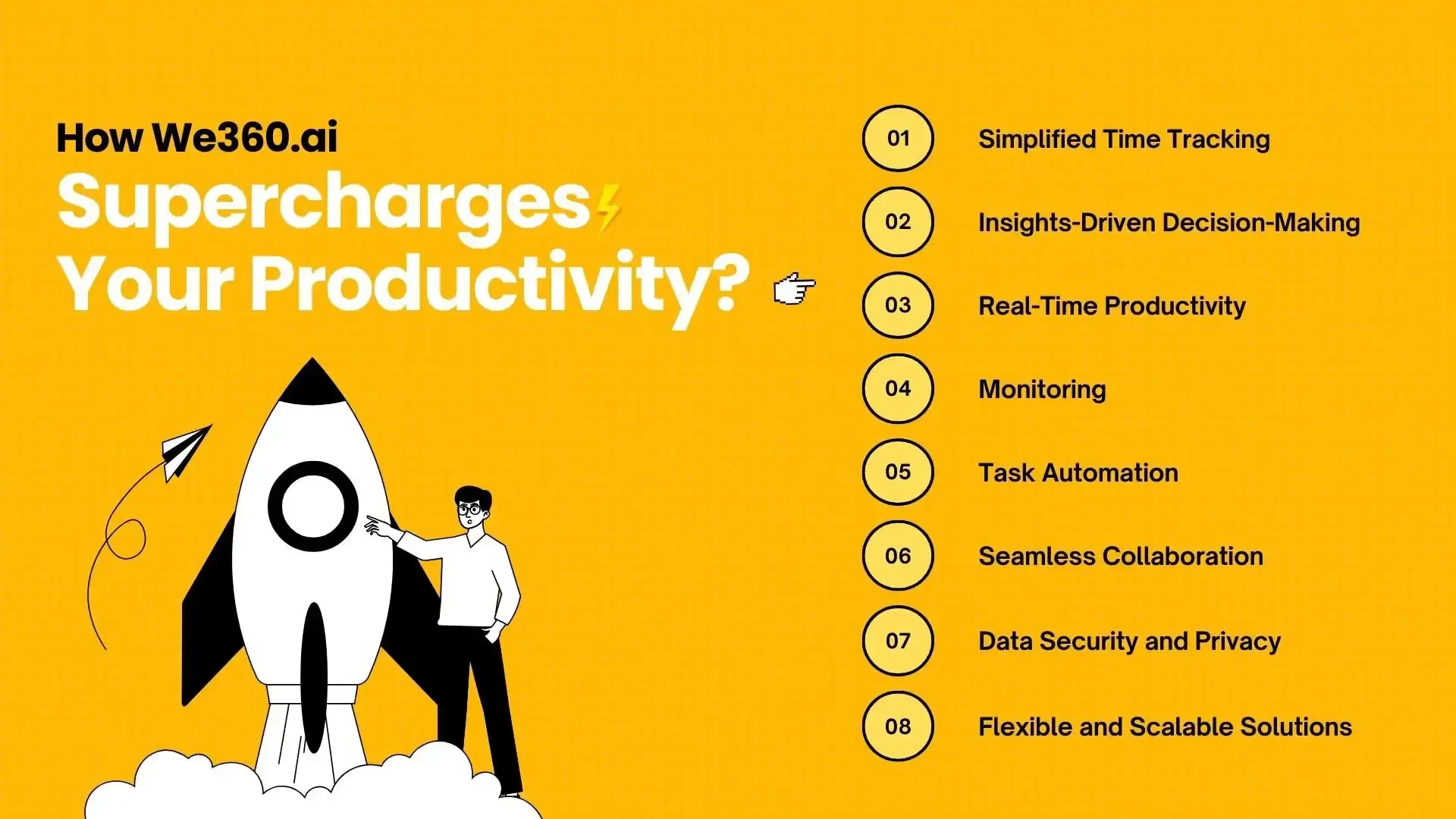
Feature | What Does It Do? | Why It Matters? |
Simplified Time Tracking | Automates time tracking, ensuring every minute is accounted for without manual effort. This means you spend less time tracking and more time achieving your goals. | It gives you clarity on how time is being spent, helping you eliminate unproductive habits. |
Insights-Driven Decision-Making | With detailed analytics and reports, We360.ai provides insights into your daily operations. | These insights help identify bottlenecks and optimize processes, whether reallocating resources or streamlining tasks. |
Real-Time Productivity Monitoring | The platform offers live productivity monitoring for teams, giving managers a clear picture of where time and energy are being spent. | It encourages accountability while ensuring that team members are aligned with key objectives. |
Project & Task | Reduces the burden of repetitive tasks by automating routine workflows. | Automation frees up your time to focus on high-priority, value-driven tasks. |
Seamless Collaboration | Team members can align on goals and share progress, making collaboration seamless and transparent. | Clear communication fosters better teamwork and faster project completion. |
Enhanced Employee Engagement | The platform tracks employee productivity in a way that supports, rather than pressures, your team. | It helps managers identify areas for support and growth, boosting morale and overall output. |
Data Security and Privacy | It ensures your data is secure and handled carefully so you can focus on work without worries. | Productivity tools should simplify work, not create concerns about sensitive information. |
Flexible and Scalable Solutions | Whether you're managing a small team or a large organization, it helps in adapting to the needs. | The solution grows with you, ensuring constant productivity as you scale. |
Your Roadmap to More Productive 2025
As we enter 2025, we must remember that productivity is not about doing more but about accomplishing meaningful goals. You can easily focus on meaningful outcomes and maintain healthy working patterns and environments by directly implementing the abovementioned hacks.
Set clear priorities and focus on investing in tools for automation and creating the space that will help boost focus at every step. If you are looking for an all-in-one tool and a productivity partner, then We360.ai will be a game changer.
Let's kickstart 2025 in the right ways!
Related Posts
Understand digital presenteeism and why being constantly online does not always mean being productive. Explore how excessive availability, unnecessary meetings, notifications, and screen time can impact focus, employee well-being, and performance. Learn practical strategies to measure meaningful productivity, reduce digital overload, set healthy boundaries, and build more effective work environments.

Learn the difference between proactive and reactive work habits and why being proactive can improve productivity, decision-making, and workplace performance. Discover practical strategies to anticipate challenges, prioritize tasks, plan ahead, manage time effectively, reduce distractions, and build proactive habits that help employees and teams work smarter, stay organized, and achieve better results.

Discover the common causes of low productivity and practical ways to fix them. Learn how poor time management, unclear goals, distractions, burnout, ineffective communication, workload issues, and outdated processes affect performance. Explore actionable strategies businesses and employees can use to improve focus, efficiency, engagement, and overall workplace productivity without creating unnecessary pressure.
Learn how different working styles influence communication, collaboration, productivity, and team performance. Discover how to identify individual work preferences, manage diverse personalities, improve teamwork, reduce workplace friction, and create an inclusive environment. Explore practical strategies for managers to support a mixed team and help every employee work effectively.