
Gallup's 2023 "State of the Global Workplace" report states that 59% of the global workforce comprises quiet quitters. It means more than half of employees are mentally checking out while still clocking in.
Quiet quitting isn’t a buzzword; it’s a silent productivity crisis hiding in plain sight. What makes this trend more concerning is its occurrence: disengagement doesn’t announce itself. It creeps in quietly, through missed enthusiasm, muted collaboration, and a growing emotional distance between employees and their work.
As companies continue navigating post-pandemic burnout, hybrid work pressures, and rising stress levels, the ability to detect these early behavioral shifts has never been more critical. Data, often overlooked in the context of emotional and cultural issues, has emerged as a powerful tool to uncover disengagement long before it snowballs into turnover, poor performance, or team-wide demotivation.
What is quiet quitting?
Quiet quitting doesn’t mean your employees quitting their jobs. It simply means doing the bare minimum and getting on with life. COVID-19 has fueled stress, burnout, and falling engagement among workers. It’s an increasingly common term, also known as silent quitting or quiet resignation, which differs from regular quitting.
In this scenario, employees barely raise their dissatisfaction vocally; they just stop putting extra effort into their jobs.
As Sarah Skidmore, CEO of a consulting company, says, “it’s just having healthy boundaries that prevent long-term burnout and some retention issues that overworked teams face.”

What is the symptom of quiet quitting?
Now that you know what quiet quitting is, you may want to identify factors your employees exhibit before displaying it.
- Lowered engagement
Employees show lowered motivation in working on new projects and their contribution to team efforts becomes negligible. In the U.S., Gallup finds that “quiet quitters” make up at least 50% of the workforce.
- Reduced communication
These employees barely collaborate in team meetings, especially in remote or hybrid settings.
- Zero interaction with management
Lesser communication with management signals disinterest. There is a lack of connection between personal and organizational goals. Only 27% of U.S. workers “strongly agree” that their supervisor keeps them updated with what is going on in the organization.
- Strict on timelines
Employees arrive on time and leave on time displaying minimal flexibility on project timelines.
Top causes of disengaged employees in today’s workplace
People’s mental well-being is worsening. In the last 10 years, the number of people expressing stress, sadness, anxiety, anger or worry has been on the rise, snowballing to its highest levels since the Gallup surveys began .” 2023-2024 Human Development Report, United Nations Development Programme.
The chief causes of disengagement in employees are:
- Burnout and stress
The increasing demand of hybrid work, long working hours and burdensome expectations cause employees to burnout. At the same time their effort isn’t appreciated causing them to withdraw as a means of self-preservation. According to Gallup’s State of the Global Workplace (2024) report, 41% of employees report experiencing “a lot of stress”.
- Minimal growth opportunities
Career stagnation is a common reason for disengagement: reports show 35%–46% of employees cite lack of career advancement opportunities as a key issue. When employees don’t see a clear path of growth and skill development, they take time off work hours to self-educate themselves. If their input isn’t translating into meaningful career progression, they retreat into doing the bare minimum.
- No recognition
When employees do not feel appreciated for their contribution, it lowers their morale causing them to go quiet. This causes them to stop going over and beyond, thus disengaging.
- Poor management
Managers are extremely influential: 70% of the variance in employee engagement is attributable to the manager. One of the core reasons for employees' disengagement is poor leadership. Repeated micromanagement, lack of support and growth upgradations can easily demotivate employees.
How to combat quiet quitting?
You can reverse quiet quitting with intentional, people-centric strategies that rebuild trust, spark motivation, and strengthen connections. Start with:
- Fostering open communication
Open communication is the cornerstone of a healthy work culture. The employees must feel comfortable expressing their views without fear of judgment or retaliation. As a leader, you can step into your employees' shoes and gauge roadblocks to avoid them as and when needed.
- Launching reward program
Recognition fuels potential. When employees are acknowledged for their hardwork and efforts, they are likely to stay committed and engaged. The recognition should be personalized and specifically offered for individual efforts and not always as generic praise.
- Promoting work-life balance
Employees must be encouraged to take interim leaves and celebrate a work-life balance. They must enjoy vacations and leaves that refresh them and instill a zeal in them to perform above and beyond their capacity.
- Introducing growth opportunities
Launch skill-enhancement programs. Invite soft-skill trainers and motivate your employees to take online courses to upskill their potential and stay grateful. Invest in upskilling programs, mentorship opportunities, and workshops that help employees advance in their careers.
How We360.ai helps in identifying quiet quitting?
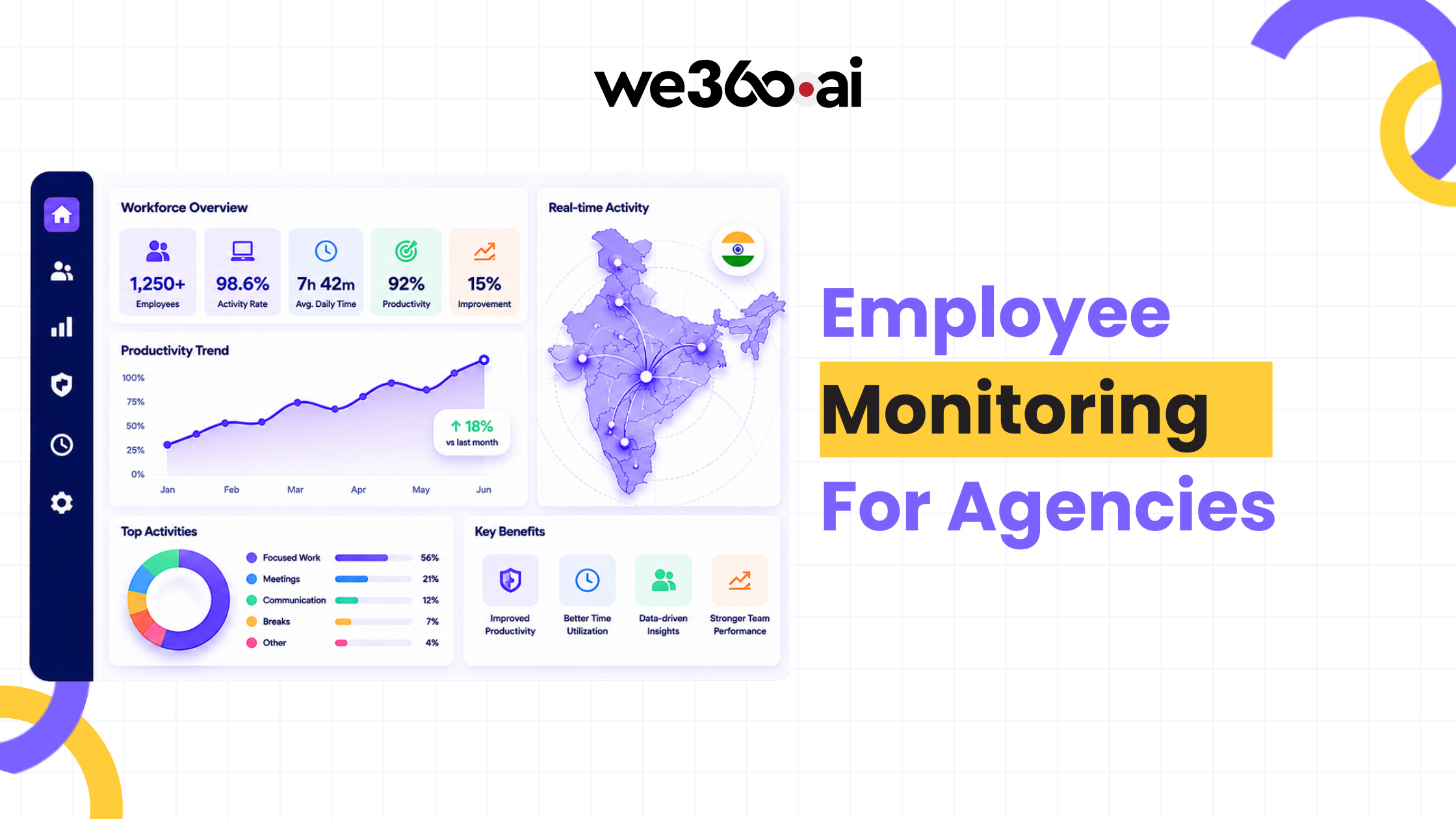
We360.ai is an employee productivity monitoring tool that helps you:
- Track productivity patterns to spot sudden drops in activity, reduced initiative, or consistent “bare-minimum” output.
- Monitor attendance behaviour, highlighting strict log-in/log-out routines and lack of flexibility that signal disengagement.
- Analyze collaboration levels by identifying reduced communication, minimal participation in team tasks, or declining tool usage.
- Provide real-time dashboards that reveal behavioural shifts and make it easy to compare individual trends with team averages.
- Capture employee sentiment through surveys and pulse checks to uncover emotional disconnect or dissatisfaction early.
- Identify burnout risks using screen-time trends, break behaviour, and workload insights that often trigger quiet quitting.
- Deliver a holistic view of productivity and well-being so managers can intervene with timely support, recognition, or coaching.
If you want to surface your quiet quitters, Book a FREE demo of we360.ai now!