

Introduction: When Visibility Starts to Feel Like Surveillance
In 2026, most organizations have some form of workforce analytics in place. Screens are tracked. Apps are monitored. Dashboards are full.
And yet, many CEOs and HR leaders are asking a different question:
Are we building performance—or quietly eroding trust?
The shift to hybrid and distributed work across India, Southeast Asia, the Middle East, Europe, and North America has made visibility essential. But visibility without empathy quickly turns into surveillance. And surveillance—real or perceived—can damage morale, increase attrition, and create compliance risks under evolving data privacy frameworks.
This guide explores how to balance operational insight with employee dignity. You’ll learn:
- Why traditional monitoring models are failing in 2026
- What “employee-first analytics” actually means
- How to design transparent, ethical data practices
- How leaders can protect morale while improving performance
Because the real competitive advantage isn’t more data.
It’s better judgment about how you use it.
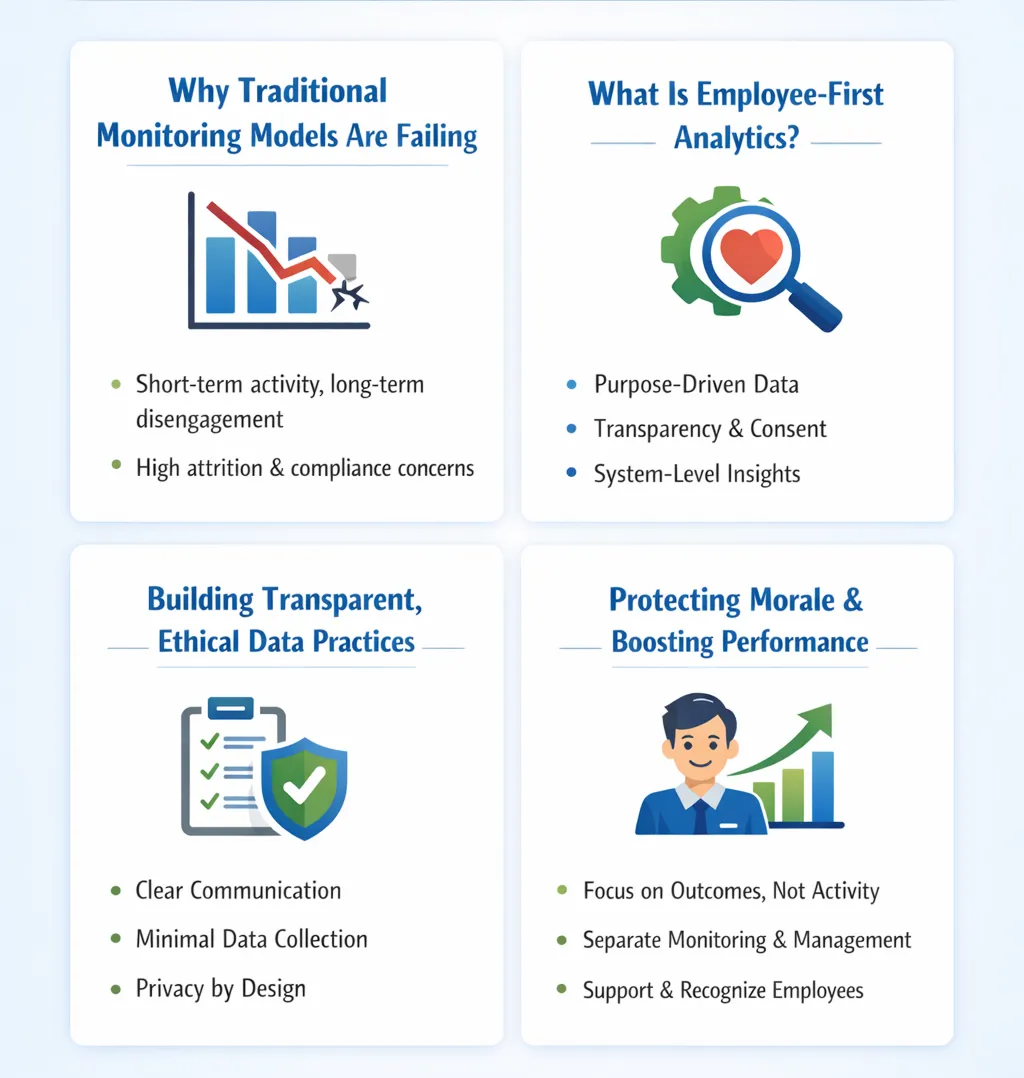
Why Traditional Employee Monitoring Is Backfiring in 2026
Many workforce analytics tools were built around a simple assumption:
More visibility equals more productivity.
In reality, the opposite often happens.
The Hidden Costs of Surveillance-Heavy Systems
Across industries—from IT services in Bengaluru to financial services in London—leaders report similar patterns:
- Increased short-term activity
- Reduced long-term engagement
- Higher employee anxiety
- Rising attrition in high-performing roles
When employees feel watched rather than supported, behavior changes. They optimize for appearance, not impact.
For example:
- Staying “active” on systems rather than solving complex problems
- Avoiding creative exploration that doesn’t show immediate output
- Reducing collaboration due to fear of misinterpretation
From a CEO’s lens, this creates a dangerous illusion: dashboards show activity, but innovation slows.
Compliance Is No Longer Optional
Regulatory expectations have also evolved. Data protection frameworks across regions—such as India’s Digital Personal Data Protection Act (DPDP), Europe’s GDPR standards, and similar privacy laws emerging across the Middle East and Asia-Pacific—are forcing organizations to rethink how employee data is collected and processed.
In 2026, compliance is not just a legal requirement. It’s a brand issue.
Employees increasingly evaluate employers based on:
- Data transparency
- Ethical technology use
- Respect for digital boundaries
Surveillance without clarity is now a reputational risk.
What Is Employee-First Analytics?
Employee-first analytics doesn’t mean “no monitoring.”
It means purpose-driven visibility.
At its core, employee-first analytics answers three questions:
- What decision will this data support?
- Is this data necessary for that decision?
- Does the employee understand and consent to its purpose?
The Shift: From Policing to Pattern Recognition
Instead of tracking individuals to find faults, modern workforce intelligence focuses on patterns:
- Where are workflows breaking?
- Where do teams lose time across systems?
- Which processes create bottlenecks?
- Are workloads unevenly distributed?
The goal is to fix systems—not flag people.
For example, if response times drop in a support team:
- A surveillance approach asks: “Who is underperforming?”
- An employee-first approach asks: “Is ticket volume spiking? Is the knowledge base outdated? Are shifts misaligned?”
The difference is cultural—and financial.
Companies that analyze patterns rather than micromanage individuals report:
- Better cross-team collaboration
- More accurate performance conversations
- Lower burnout rates
That’s not soft culture talk. That’s operational efficiency.
How to Balance Visibility and Morale: A Practical Framework for Leaders
Balancing surveillance and morale isn’t philosophical. It’s structural.
Here’s a framework senior leaders can apply immediately.
1. Define Clear Intent Before Deploying Any Monitoring Tool
Before enabling any workforce tracking feature, leadership must document:
- What problem are we solving?
- What metrics matter?
- How will this improve employee experience?
If the answer is vague (“just to see what’s happening”), it’s not ready.
Clarity prevents misuse.
2. Communicate Transparently—Not Technically
Employees don’t resist analytics.
They resist ambiguity.
Explain:
- What data is being collected
- Why it’s collected
- Who can access it
- How it impacts evaluations
In many Indian and Southeast Asian enterprises, trust improves dramatically when HR hosts open Q&A sessions about analytics policies. Transparency reduces speculation.
And speculation is morale’s biggest enemy.
3. Measure Output, Not Activity
Activity is easy to track.
Impact is harder—but far more valuable.
For CEOs and CXOs, this distinction matters.
If marketing teams are evaluated by hours online rather than campaign results, behavior skews toward performative work.
If software engineers are judged by keystrokes instead of deploy quality, innovation declines.
Employee-first analytics prioritizes:
- Task completion quality
- SLA adherence
- Customer outcomes
- Revenue impact
- Process improvement contributions
Activity becomes context—not the metric.
4. Separate Performance Management from Behavioral Surveillance
This is critical.
When analytics tools double as disciplinary systems, trust collapses.
Instead:
- Use data to identify trends
- Use managers to interpret context
- Use conversations to understand variance
A drop in activity could indicate:
- Burnout
- Complex task engagement
- Personal emergencies
- System inefficiencies
Data shows signals.
Leadership interprets meaning.
The Business Case: Why Employee-First Analytics Protects the Bottom Line
Balancing surveillance and morale isn’t just ethical. It’s financially intelligent.
Reduced Attrition Costs
Replacing a mid-level knowledge worker in India, the UAE, or the UK can cost 50–150% of their annual salary when recruitment, onboarding, and lost productivity are considered.
High-surveillance cultures often accelerate voluntary exits.
A morale-conscious analytics approach reduces that risk.
Better Decision-Making at the Executive Level
When dashboards focus on meaningful patterns rather than noise, leadership sees:
- Where automation is required
- Which teams need structural redesign
- Where client demands are misaligned with staffing
- Which processes consume non-billable hours
This shifts conversations from “who is slow?” to “what is broken?”
That distinction transforms boardroom strategy.
Stronger Employer Branding in Competitive Talent Markets
In 2026, top talent evaluates companies not just on salary—but on digital ethics.
Organizations in technology hubs like Bengaluru, Hyderabad, Dubai, and Singapore are already seeing this shift.
Candidates ask:
- “How do you monitor employees?”
- “Is there screenshot tracking?”
- “Is keystroke logging used for performance ratings?”
The answers influence acceptance rates.
Employee-first analytics becomes part of your employer value proposition.
The Future of Workforce Analytics: Trust as Infrastructure
Work is no longer location-bound. It is data-bound.
As hybrid and remote models stabilize globally, analytics will remain essential. But the future belongs to organizations that treat trust as infrastructure—not as an afterthought.
The companies that will win in 2026 and beyond are those that:
- Design analytics policies collaboratively
- Audit data usage regularly
- Train managers in responsible interpretation
- Align monitoring with employee well-being
- Balance compliance with culture
Surveillance creates short-term control.
Trust creates long-term performance.
And long-term performance is what CEOs are measured on.
Conclusion: Visibility Without Fear
The debate is no longer “Should we monitor employees?”
The real question is:
How do we gain operational clarity without sacrificing morale?
Employee-first analytics offers a path forward. It reframes data from a tool of control into a tool of improvement. It focuses on systems, not suspicion. Patterns, not punishment.
For leaders navigating hybrid work, global compliance, and rising employee expectations, the balance between surveillance and morale isn’t optional—it’s strategic.
In 2026, the smartest organizations won’t collect the most data.
They’ll use the right data—responsibly.
FAQ: Balance Surveillance & Morale in 2026
If your organization is evaluating its workforce analytics strategy for 2026, this is the moment to pause and ask:
Are we building oversight—or building trust?
.png)