
Organizations in 2026 face a persistent challenge: understanding how work actually happens across distributed teams, digital tools, and evolving workflows. Traditional productivity metrics no longer reflect the realities of hybrid and knowledge-based work. Leaders need deeper visibility into workforce behavior to improve performance and efficiency.
AI workforce analytics is the practice of using artificial intelligence to analyze work patterns, digital activity, and operational behavior across employees and teams. It reveals hidden workforce trends that conventional reporting cannot detect. A workforce analytics platform powered by AI helps organizations understand productivity drivers, workload balance, and workflow friction with measurable clarity.
The Productivity Visibility Gap in Modern Organizations
Many companies invest in productivity monitoring tools, time tracking software, and performance dashboards. Yet they still struggle to explain productivity differences across teams, roles, and regions.
Common challenges include:
- Limited visibility into how employees actually spend time across applications and tasks
- Inconsistent productivity patterns across hybrid and remote teams
- Difficulty identifying workflow bottlenecks and context switching
- Overreliance on surface metrics such as hours logged or tasks completed
- Lack of objective data to guide workforce planning decisions
- Unclear connections between employee activity and business outcomes
These gaps create uncertainty for leaders responsible for operational performance. Without reliable workforce analytics, productivity management becomes reactive rather than strategic.
As work environments become more digital and distributed, hidden patterns increasingly determine efficiency. Organizations need systems that translate workforce behavior into actionable insights rather than assumptions.
What is AI Workforce Analytics?
AI workforce analytics is the use of artificial intelligence to analyze employee work patterns, digital activity, and productivity behavior across tools and workflows. It converts workforce data into insights about efficiency, workload distribution, and operational performance to support data-driven workforce management decisions.
How AI Workforce Analytics Works
AI workforce analytics platforms collect and analyze large volumes of work activity data across enterprise environments. The goal is to transform raw activity signals into meaningful productivity insights.
A typical system:
- collects data such as application usage, task duration, workflow sequences, and collaboration patterns
- analyzes behavior trends across teams, roles, and time periods
- provides insights into productivity drivers, bottlenecks, and workload balance
- helps organizations optimize processes, staffing, and digital workflows
Unlike basic employee monitoring software that tracks presence or time, AI-driven systems interpret context. They distinguish productive effort from idle time, deep work from fragmented work, and structured workflows from inefficient patterns.
Over time, these insights reveal hidden workforce trends such as:
- recurring productivity dips across certain shifts
- excessive tool switching in specific processes
- uneven workload distribution within teams
- regional workflow variations in global operations
This continuous analysis allows leaders to understand not only what work is done, but how efficiently it happens.
Why AI Workforce Analytics Matters for Growing Organizations
Workforce complexity increases as companies scale, adopt hybrid work models, and expand across regions. Visibility into workforce behavior becomes essential for maintaining operational consistency and performance.
AI workforce analytics supports strategic decision-making in several ways.
It enables operational efficiency by identifying workflow friction and wasted effort across digital processes. Leaders can redesign workflows based on objective evidence rather than assumptions.
It improves workforce visibility across remote and hybrid teams. Managers gain clarity into work patterns without relying on physical supervision or self-reported activity.
It strengthens data-driven decision-making in workforce planning. Staffing levels, role allocation, and process changes can be guided by measurable productivity trends.
It supports hybrid workforce management by revealing differences between in-office and remote productivity patterns. Organizations can adapt policies and support structures accordingly.
It aligns employee activity with business outcomes. Leaders can connect effort distribution with service levels, delivery timelines, and operational costs.
These capabilities make AI workforce analytics increasingly central to enterprise productivity tracking strategies.
How We360.ai Reveals Hidden Workforce Trends
We360.ai applies AI workforce analytics to provide organizations with continuous visibility into productivity behavior across teams and workflows. The platform translates digital activity into interpretable workforce insights that leaders can act on.
It identifies productivity patterns across roles, departments, and time periods. It highlights workflow bottlenecks, collaboration overload, and task fragmentation. It also reveals workload imbalances that affect performance and employee experience.
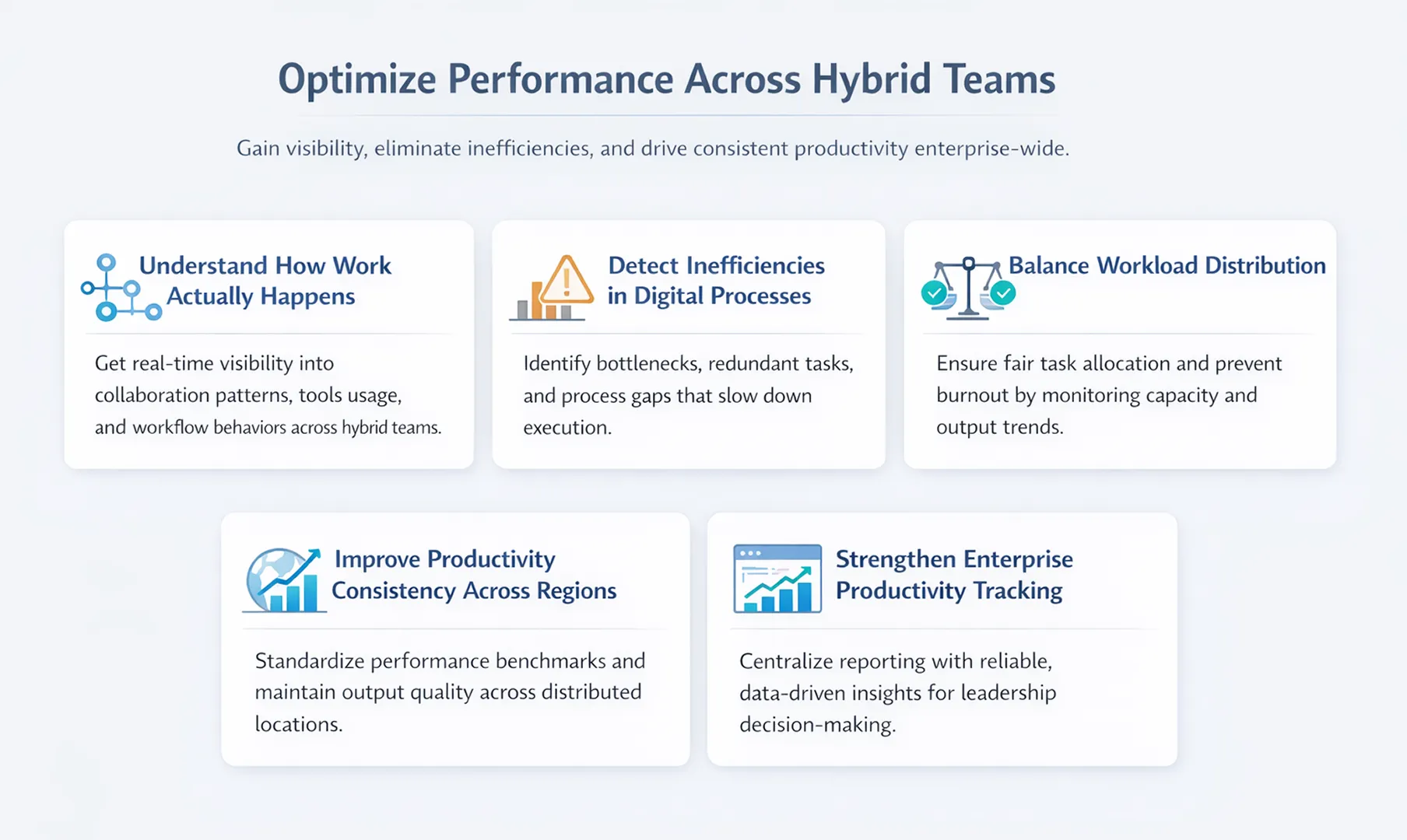
These insights help organizations:
- understand how work actually happens across hybrid teams
- detect inefficiencies in digital processes
- balance workload distribution
- improve productivity consistency across regions
- strengthen enterprise productivity tracking
By converting workforce data into operational intelligence, organizations gain clarity that traditional productivity monitoring tools cannot provide. This clarity supports informed workforce decisions and continuous performance improvement.
Start your free trial today.