
Why So Much Data Still Fails to Improve Margins
Most leadership teams agree on one thing: data is everywhere, but clarity is not.
Organizations track hours, productivity, costs, and performance metrics across departments. Dashboards look impressive, yet EBITDA often remains under pressure. The reason is simple—data is frequently observed, not understood. It tells what happened, but not why, where value is leaking, or which decisions actually move financial outcomes.
For CEOs, CXOs, and HR leaders, this disconnect is costly. Margins are shaped by everyday work patterns: how time is used, where effort is misaligned, and which processes quietly drain resources. Without visibility into these operational realities, growth initiatives rely on assumptions.
This is where advanced workforce analytics changes the conversation. Instead of treating productivity data as an operational afterthought, it becomes a financial lever. In this blog, we explore how organizations move from raw workforce data to measurable EBITDA impact—and why some are seeing gains as high as 32% by making this shift.
Why EBITDA Growth Is an Operational Problem, Not Just a Financial One
EBITDA is often discussed in boardrooms, but it is created on the ground.
Margins are shaped by thousands of small decisions made daily—how teams allocate time, how managers distribute work, and how processes evolve without oversight. When these decisions are misaligned, costs increase without anyone noticing.
Common margin killers include:
- Underutilized paid hours
- Inefficient workflows that grow over time
- High-performing teams overloaded while others remain idle
- Manual work that persists simply because it is invisible
Finance teams see the impact only after costs are incurred. By then, the opportunity to course-correct has passed. EBITDA pressure, in this sense, is rarely sudden—it accumulates quietly.
Advanced workforce analytics reframes EBITDA as an operational outcome. It connects how work happens to how money is made or lost, enabling leaders to intervene earlier and with precision.
What “Advanced Analytics” Really Means for Workforce Decisions
Advanced analytics is often misunderstood as complex models or abstract metrics. In practice, it is much more practical.
At its core, advanced workforce analytics examines patterns across:
- Time utilization versus paid hours
- Task-level effort versus business value
- Productivity consistency across teams and roles
- Process friction that inflates cost without improving output
Rather than asking, “Are people busy?” it asks:
- Where is time creating value?
- Where is effort being wasted?
- Which activities directly support revenue or client outcomes?
Platforms such as We360.ai approach this by translating everyday activity data into insights that leaders can actually act on. The goal is not monitoring—it is understanding how operational behavior affects financial performance.
For senior leaders, this clarity matters more than volume. One clear insight tied to cost or output can be more valuable than ten generic productivity reports.
The Hidden Link Between Workforce Efficiency and EBITDA
EBITDA growth through analytics does not come from pushing teams harder. It comes from removing inefficiencies that were previously invisible.
1. Exposing Cost Leakage in Plain Sight
Most organizations pay for time that does not translate into meaningful output. This is rarely due to intent—it is usually the result of unclear priorities or outdated processes. Analytics surfaces where paid effort consistently fails to produce value, allowing leaders to fix the system rather than blame individuals.
2. Improving Output Without Increasing Headcount
When leaders understand real capacity, they stop hiring to solve productivity problems. Work is redistributed, bottlenecks are removed, and output increases within existing teams. This directly improves EBITDA by controlling operating expenses.
3. Aligning Work with Business Priorities
Analytics highlights whether teams spend time on revenue-linked or support activities. When misalignment is corrected, organizations see stronger margins without structural changes.
4. Reducing Decision Lag
Instead of waiting for quarterly reviews, leaders see patterns as they emerge. Faster decisions mean smaller course corrections—and smaller corrections protect margins.
These changes compound over time. What starts as operational visibility gradually reflects in financial statements.
How Organizations Translate Insights Into Measurable EBITDA Gains
Seeing data is not enough. EBITDA growth comes from how insights are applied.
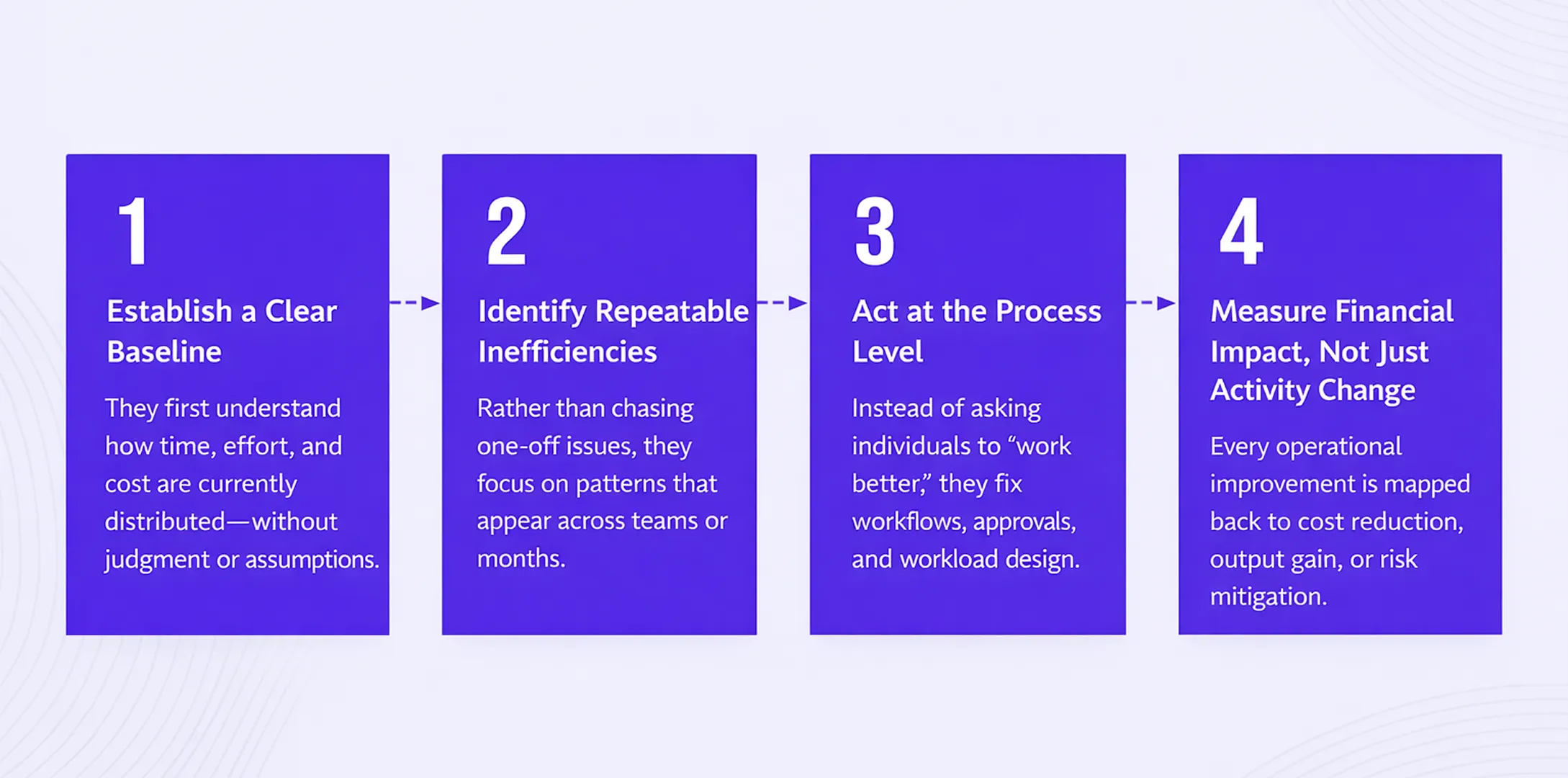
High-performing organizations follow a simple but disciplined approach:
Step 1: Establish a Clear Baseline
They first understand how time, effort, and cost are currently distributed—without judgment or assumptions.
Step 2: Identify Repeatable Inefficiencies
Rather than chasing one-off issues, they focus on patterns that appear across teams or months.
Step 3: Act at the Process Level
Instead of asking individuals to “work better,” they fix workflows, approvals, and workload design.
Step 4: Measure Financial Impact, Not Just Activity Change
Every operational improvement is mapped back to cost reduction, output gain, or risk mitigation.
This is how analytics-driven organizations report EBITDA improvements in the range of 20–30% over time—not through drastic cuts, but through disciplined optimization.
Why This Matters More in 2026 Than Ever Before
Workforce complexity is increasing. Hybrid models, regional compliance requirements, and rising labor costs mean that inefficiency is no longer affordable.
In regions like India, Southeast Asia, and the Middle East—where service-led growth is prominent—small productivity gaps scale quickly across large teams. Meanwhile, global organizations face increasing scrutiny on cost transparency and operational efficiency.
Advanced workforce analytics provides a common language between operations, HR, and finance. It replaces debate with evidence and intuition with insight. For leaders navigating growth in uncertain conditions, this alignment is becoming a necessity, not a differentiator.
EBITDA Is a Byproduct of Better Visibility
EBITDA growth rarely comes from a single bold move. It is the result of hundreds of small, informed decisions made consistently over time.
Advanced workforce analytics helps leaders see what was previously hidden—how time, effort, and cost interact every day. By translating operational data into financial clarity, organizations move from reactive cost control to proactive margin improvement.
For CEOs and CXOs, the takeaway is simple: when you understand how work truly happens, financial performance stops being a mystery. It becomes manageable, measurable, and sustainable.
Frequently Asked Questions