
The same work environment drives some employees on adrenaline rush while others not making the grade. Some of your employees enjoy working in a collaborative environment and others excel when they are left at their own pace. It’s pivotal to identify the traits of your employees and customize your workforce productivity tool based on workstyles.
In Deloitte’s 2025 Global Human Capital Trends survey, 67% of leaders said customizing workforce practices (based on skills, behavioral patterns, motivations, work styles, etc.) is important. But only 5% of organizations are leading in hyper-personalization, and just 17% have efforts underway.
You may want to understand your employees and what their workstyle is. But, the question before this is, what is the term “workstyle”?
What is a workstyle?
A workstyle is a behavior or attribute that your employees display at your workplace. However, over-marginalizing personality types and other demarcations can lead to limiting beliefs about one’s potential. Setting a stereotype for oneself can lead to impostor syndrome, slip into negativity and lower team morale.
Therefore, do not set standards for your team. Be flexible. Identify their strengths and weaknesses. Introduce them to amplify your team’s performance and not limit them. Gallup reports that “highly engaged teams” deliver 21% greater profitability, which reinforces the fact, a workplace is an environment where all employees, irrespective of their workstyle work in unison.
What are different types of workstyles for employees?
Each employee has a distinct workstyle. Some are self-motivated, others need a push. Let’s dive in and understand the most popular employee types.
Detail-oriented
Detail-oriented employees can leverage small details from the productivity app by creating checklists. This emphasizes that employees who may or may not be geniuses stick to a system of checklists to get things done. Other than checklist, they can rely on Kanban board and deep-work window for uninterrupted focus and accurate results.
Supportive
Supportive employees are the cornerstones of a well-thriving company. They collaborate easily, share knowledge and happily help colleagues. However, more often than not, they get pulled into others’ tasks and struggle with setting boundaries. An employee productivity app nudges them when they are looking at others’ work ignoring their own and autoflagging overload if they exceed capacity.
Creative
These employees work best in a non-rigid work environment where they can promote ideas and perform effectively despite varying energy levels. Productivity apps tailored to them push idea-first rather than task-first and mind-map styled brainstorming more frequently to capture flashes of inspirational ideas.
Logical
Logical employees thrive on structure, data-backed insights and task management. Productivity apps should be used to identify areas of productivity that need improvement and send alerts in case of lagging. These employees are driven by problem-solving, critical thinking and reasoning. Productivity apps should drive them with data so that every detail is quantifiable.
Cooperative
A cooperative employee has high ethical values, is a strong team player and has excellent communication skills. They enjoy working with others, sharing ideas and assisting the team as a whole to achieve objectives. 75% of employers say teamwork and collaboration are “very important.” This makes cooperative employees the most popular employee type.
Analytical
These employees work based on data-driven insights and are detail-oriented. They excel at problem-solving and critical thinking. With dashboards that highlight bottlenecks, performance trends, and workload distribution it helps them optimize their processes with precision.
Independent
Independent employees focus on autonomy and minimal micromanagement. Your productivity app should give them freedom and unobtrusive work styles. They should be able to set their own priorities via Kanban boards, timelines or simple lists.
While you may identify yourself as one of these workstyles, you also need to understand your employees’ communication styles based on DISC (Dominance, Influence, Steadiness and Conscientiousness).
What is DISC?
DISC is a psychometric testing tool that evaluates an individual’s key workplace behavioural styles.
For instance, do you ever wonder how some people get so much done in a day while other employees struggle to do even small tasks? In the quest to work off tasks, do your employees overlook one crucial factor i.e., individual workstyles? It plays a crucial role in understanding how our approach makes even massive tasks a cakewalk to implement. It implies that if your team has a sprinter training for a marathon, they may not give their best shot. The same applies to your workstyle. Your team should train and work in ways that complement their natural abilities.
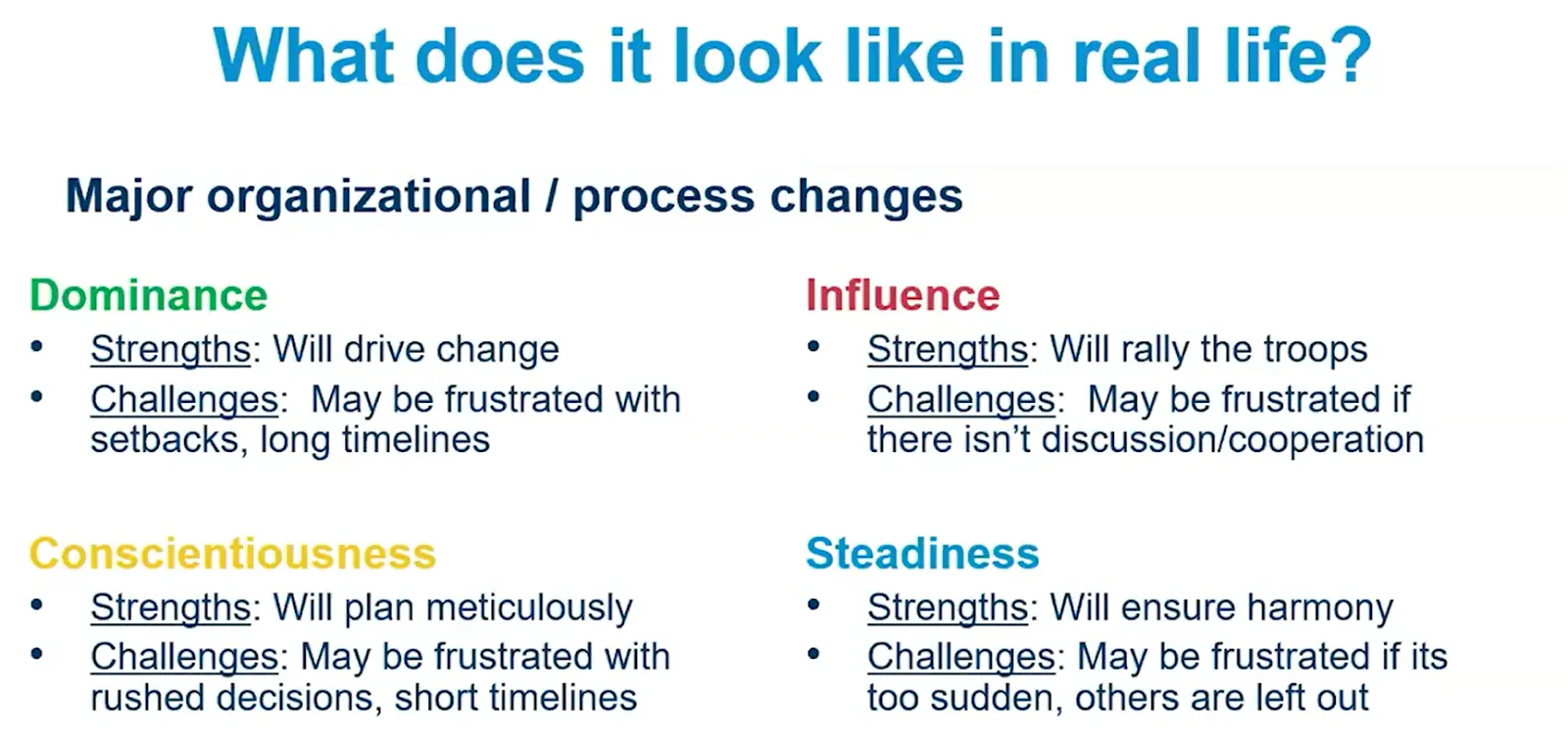
DISC looks like:
What are the factors in DISC workstyle?
- Dominance
People with a Dominance workstyle are direct and impulsive. They speak before thinking and are driven by facts. They at times fail to understand others’ feelings, in turn hurting others.
How to improve: They need to listen more and understand that they do not necessarily have all the answers.
- Influence
They are enthusiastic and energetic communicators thriving on positivity. Their trait is to openly interact with others and not focus on details. They are empathetic, naturally cognizant of others’ feelings.
How to improve: They can benefit from incorporating more structure and focusing on follow-through. Balancing their enthusiasm with a little bit of practicality can lead to better outcomes.
- Steadiness
They are calm and supportive. Steadiness types are empathetic and great listeners, considerate of others’ feelings.
How to improve: They can be more assertive and open to change. Expressing their own ideas and embracing change can lead to better outcomes.
- Conscientiousness
C-type are precise and analytical with careful attention to detail. They bring a sense of order in communication and are usually reserved, thinking and analyzing before speaking.
How to improve: C-type can be more flexible and open to different perspectives.
DISC profile assessment helps understand your team members' personalities, communication styles, and work preferences for better recruitment and retention.
How we360.ai personalizes as per your employees’ workstyles?
We360.ai is a people analytics tool helping you chalk out strategies based on your employees’ workstyles. It can provide insights into employee preferences, strengths, and working styles.
We360.ai personalizes the entire productivity experience making monitoring feel supportive, not intrusive and helping teams perform at their best while honoring individual workstyles.
- Helps employees work in a way that feels natural to them.
- Reduces stress by removing unnecessary notifications and noise.
- Improves focus with insights tailored to employees' work patterns.
- Boosts productivity without forcing a one-size-fits-all workflow.
- Makes performance tracking feel fair and relevant.
- Encourages healthier work habits and prevents burnout.
- Supports different workstyles - analytical, creative, independent, cooperative, etc.
- Increases engagement because employees feel understood, not monitored.
- Builds trust by showing insights that actually help, not micromanage.
- Helps managers make better decisions based on real, personalized data.
If you too want to bring out the best in your employees, book a FREE DEMO with we360.ai today!