

The conversation around remote work has fundamentally shifted. What began as a pandemic-driven experiment has evolved into a strategic business advantage that separates industry leaders from the rest.
As we navigate 2026, organizations that understand and adapt to emerging remote work trends are capturing top talent, boosting productivity, and building resilient operations that transcend geographical boundaries.
This comprehensive guide explores what smart companies are doing differently in the remote work space and how your organization can stay ahead of the curve.
Why Remote Work Is Still Growing (And Why It Matters)
Before diving into specific strategies, let's establish why remote work continues to expand despite predictions of its decline.
The Demand for Flexibility Reaches All-Time Highs
The desire for workplace flexibility isn't a passing trend—it's become a non-negotiable expectation. According to recent workforce research, flexible work arrangements top the list of employee benefits, often outweighing traditional perks and bonuses. Organizations that haven't yet embraced flexible work models report significantly higher turnover rates and struggle to attract quality candidates.
Employees Now Prioritize Work-Life Balance Over Salary
The great shift in priorities has been real and lasting. When given a choice between a higher salary with rigid schedules and a competitive salary with flexibility, today's workforce chooses balance. This psychological shift, driven by lessons learned during the pandemic, has created a new employment paradigm where autonomy and time management are valued as highly as compensation.
Businesses Report Higher Productivity and Profitability
The productivity question has been definitively answered. Companies managing remote teams effectively report productivity gains of 13-16% compared to their in-office counterparts. Beyond productivity metrics, remote work reduces operational costs (office space, utilities, commute-related expenses) while simultaneously improving employee retention and reducing recruitment costs.
Remote Work Expands Global Talent Access
Perhaps the most transformative advantage of remote work is access to global talent pools. Organizations are no longer limited to local hiring markets. This geographic liberation allows companies to source specialists, reduce salary competition by hiring across regions, and build truly diverse teams. For growing companies, this competitive advantage is invaluable.
Established Remote Work Trends That Are Driving Real Results
These aren't experimental approaches; they're proven strategies that leading organizations have already implemented and optimized.
- Hybrid Work Models Have Become the New Standard
The era of pure work-from-home or pure office-based work has passed. Instead, hybrid work models, combining remote and in-office days, have become the dominant structure in 2026.
Smart companies aren't applying one-size-fits-all approaches. Instead, they're tailoring hybrid schedules to departmental needs. Marketing teams might require three days in the office for collaboration; engineering teams might opt for two. Sales teams often negotiate individual arrangements based on client locations and personal circumstances.
Organizations using asynchronous-first approaches while maintaining strategic in-office days for relationship-building, brainstorming, and complex problem-solving report the highest satisfaction scores among both employees and management.
- Outcome-Based Performance Management Replaces Hours Tracking
The shift from "where are you?" to "what are you delivering?" represents a fundamental reimagining of management philosophy.
Outcome-based performance management focuses on deliverables, quality, and impact rather than desk time. This approach requires managers to:
- Define clear, measurable outcomes for roles
- Establish transparent success metrics
- Provide autonomy in how and when work gets done
- Measure results consistently across teams
Companies implementing this framework report dramatic improvements in employee autonomy, reduced micromanagement culture, and significantly higher engagement scores. Remote and hybrid teams operating under outcome-based management show 23% higher productivity than traditionally managed teams.
- AI-Powered Workforce Management Optimizes Operations
Artificial intelligence isn't replacing managers; it's augmenting their capabilities. Smart companies deploy AI-powered tools for:
- Predictive analytics on employee burnout and retention risk
- Workload optimization that distributes tasks equitably across teams
- Skill matching that identifies which team members are best suited for specific projects
- Meeting scheduling that maximizes focus time and minimizes calendar fragmentation
- Performance pattern recognition that highlights exceptional contributions and areas needing support
These tools operate behind the scenes, freeing managers to focus on the human elements of leadership: coaching, development, and relationship building.
- Intentional Remote Work Culture Becomes Strategic Priority
Remote work culture doesn't happen by accident. Leading organizations invest deliberately in building strong cultures despite physical distance.
This includes:
- Regular virtual events that go beyond boring all-hands meetings (think: expert panels, skill-shares, casual social time)
- Clear communication protocols that ensure information flows smoothly, and no one feels left out
- Documented processes and best practices are accessible to all team members
- Recognition programs designed for remote teams (peer recognition, achievement celebrations)
- Mentorship and onboarding are structured specifically for distributed teams
- Team rituals that create shared experiences and strengthen bonds
Organizations that treat culture as a strategic initiative rather than an afterthought report 34% lower turnover and dramatically higher engagement in their remote teams.
- Continuous Coaching and Development Replace Annual Reviews
The annual performance review is dead. In its place, forward-thinking organizations implement continuous coaching and development frameworks.
This includes:
- Regular 1-on-1s focused on growth, not evaluation
- Real-time feedback loops that allow course correction immediately
- Personalized development plans aligned with career aspirations
- Microlearning opportunities integrated throughout the workweek
- Peer learning groups where employees mentor each other
- Skill development budgets that employees control
Remote-first companies report that continuous development approaches increase retention by 35% and dramatically improve promotion rates for remote employees.
- Smart Schedule Adherence Balances Flexibility with Coordination
While outcome-based management emphasizes autonomy, successful remote companies establish clear expectations about availability and collaboration.
Smart schedule adherence includes:
- Core collaboration hours where the entire team is online simultaneously for meetings and real-time work
- Flexible start/end times within reasonable parameters
- Asynchronous-first communication that doesn't require real-time availability
- Clear vacation and time-off protocols that prevent burnout
- Timezone-friendly meeting scheduling that doesn't always burden the same people with odd hours
The key distinction is that this isn't about being "always on." It's about being reliably available during agreed-upon windows while maintaining flexibility around how and when individual work gets completed.
- Personalized Employee Wellness Programs Address Remote-Specific Challenges
Traditional wellness programs designed for office employees miss critical challenges of remote work: isolation, blurred boundaries between work and home life, ergonomic issues, and a lack of informal social interaction.
Smart companies are deploying personalized wellness programs that address:
- Mental health support specifically focused on remote work challenges (loneliness, connection)
- Home office stipends and ergonomic assessments
- Fitness and movement programs adapted for home-based work
- Nutrition support and healthy eating strategies for home workers
- Family-friendly benefits recognize that remote work means more interaction with home life
- Social connection initiatives that recreate water-cooler moments virtually
- Professional development as part of wellness (career growth contributes to well-being)
Organizations investing in these comprehensive programs report 27% lower healthcare costs and dramatically higher employee satisfaction.
Emerging Remote Work Trends: Preparing for What's Next
While the above trends are established and proven, these emerging trends are shaping the future of remote work and will define competitive advantage in 2026 and beyond.
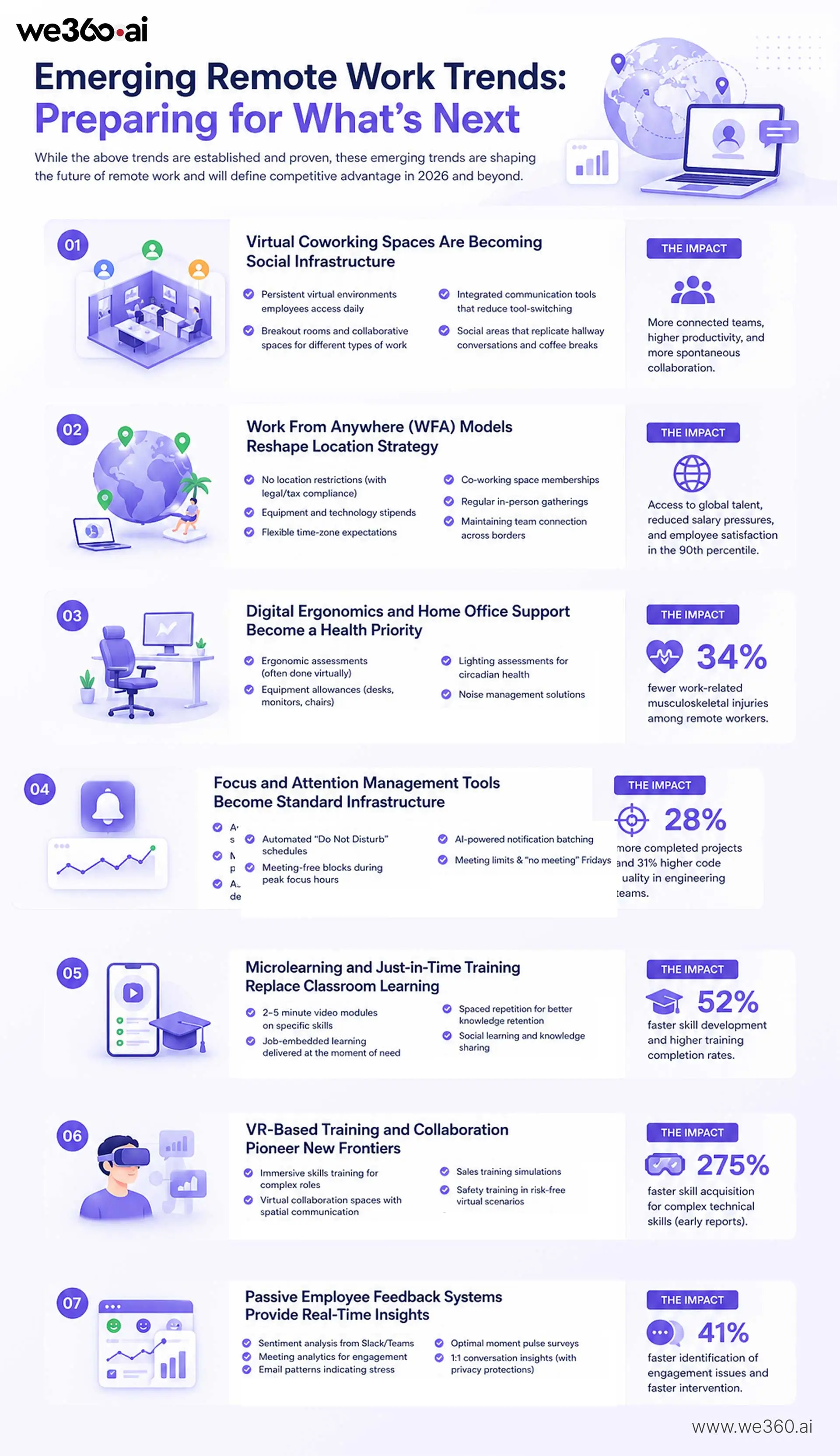
- Virtual Coworking Spaces Are Becoming Social Infrastructure
The next evolution beyond Zoom is virtual coworking spaces—persistent, designed environments where remote workers can collaborate in real-time, replicate serendipitous encounters, and build community.
These spaces feature:
- Persistent virtual environments that employees access daily
- Breakout rooms and collaborative spaces for different types of work
- Visual presence that simulates being in a physical office
- Integrated communication tools that reduce tool-switching
- Social areas that replicate hallway conversations and coffee breaks
- Time-zone bridging features that connect globally distributed teams
Forward-thinking companies are experimenting with platforms like Spatial, Gather, and Teamflow to create virtual spaces that feel more natural than traditional video conferencing. The result: remote teams report feeling more connected, productivity increases, and spontaneous collaboration opportunities increase significantly.
Related read: Remote Teams: Building Trust and Communication for Success
- Work From Anywhere (WFA) Models Reshape Location Strategy
Work-from-anywhere programs take remote-work flexibility to its logical conclusion: employees can work from anywhere in the world with minimal restrictions.
True WFA models include:
- No location restrictions (with legal/tax compliance, of course)
- Equipment and technology stipends that support work from various locations
- Flexible time-zone expectations that acknowledge global distribution
- Travel allowances that support nomadic workers or digital nomads
- Co-working space memberships for employees who need a professional environment
- Regular in-person gatherings (quarterly or bi-annual) that maintain team connection
Companies like GitLab, Automattic, and Zapier pioneered WFA models and report tremendous advantages: access to global talent pools, reduced salary pressures in expensive markets, and employee satisfaction scores in the 90th percentile.
The challenge: managing tax compliance and legal requirements while ensuring employees don't experience isolation. The companies succeeding with WFA have strong infrastructure and clear protocols.
- Digital Ergonomics and Home Office Support Become a Health Priority
As remote work becomes permanent for millions, companies are recognizing that employee health depends on proper home office setup.
Forward-thinking organizations are implementing:
- Professional ergonomic assessments of home offices (often done virtually)
- Equipment allowances (standing desks, monitors, ergonomic chairs)
- Posture and movement coaching integrated into wellness programs
- Vision care support (blue light glasses, monitor height optimization)
- Lighting assessments addressing Circadian rhythm disruption
- Noise management solutions for home environments
- Regular wellness check-ins that specifically address ergonomic issues
Companies investing in digital ergonomics report 34% fewer work-related musculoskeletal injuries among remote workers and lower workers' compensation claims.
- Focus and Attention Management Tools Become Standard Infrastructure
As meeting proliferation and notification overload threaten productivity, smart companies are deploying attention management solutions.
These tools and strategies include:
- Automated "Do Not Disturb" schedules that protect focus time
- Meeting-free blocks on team calendars during peak focus hours
- Asynchronous communication defaults that reduce interrupt-driven work
- AI-powered notification batching that groups non-urgent messages
- Focus on employee monitoring tools that respect privacy while providing aggregate attention data
- Meeting duration limits (shorter default meetings) and "no meeting" Fridays
- Deep work program that encourages and celebrates uninterrupted focus time
Teams using attention management strategies report 28% more completed projects and 31% higher code quality among engineering teams.
- Microlearning and Just-in-Time Training Replace Classroom Learning
Traditional training programs struggle with remote employees. Microlearning—short, focused learning modules delivered when needed—is becoming the standard.
Effective microlearning programs include:
- Two-to-five-minute video modules on specific skills
- Job-embedded learning that delivers training right before it's needed
- Mobile-optimized content that works on phones and tablets
- Spaced repetition algorithms that optimize knowledge retention
- Social learning features that let employees share knowledge
- Performance support tools that guide task execution
- AI-powered recommendations suggesting learning content based on role and goals
Companies deploying comprehensive microlearning programs report 52% faster skill development and dramatically higher training completion rates.
- VR-Based Training and Collaboration Pioneer New Frontiers
Virtual reality technology is moving from novelty to a practical tool for training and collaboration, especially for complex or hands-on skills.
Emerging VR applications include:
- Immersive skills training for technical, medical, or manufacturing roles
- Virtual collaboration spaces are more immersive than video calls
- Spatial communication that recreates body language and non-verbal cues
- Complex problem-solving environments where teams collaborate in shared 3D spaces
- Sales training simulations that provide realistic practice opportunities
- Safety training that allows dangerous scenarios to be practiced safely
- Executive retreats and team building in immersive environments
While still in early adoption, leading tech companies and large enterprises are pilot-testing VR training solutions. Early reports suggest 275% faster skill acquisition compared to traditional training for complex technical skills.
- Passive Employee Feedback Systems Provide Real-Time Insights
Rather than relying on annual surveys or periodic check-ins, leading organizations are deploying passive feedback systems that continuously monitor employee sentiment and engagement.
These systems capture:
- Slack/Teams sentiment analysis that identifies team mood trends
- Meeting analytics that provide insights into engagement patterns
- Email communication patterns that might indicate stress or disengagement
- Calendar analysis that shows work-life balance and meeting overload
- Voluntary pulse surveys that appear at optimal moments
- One-on-one conversation analysis (with appropriate privacy protections)
- Aggregated, anonymized insights that highlight team-level trends
Crucially, these systems maintain strict privacy protections and focus on aggregate insights rather than individual surveillance. Companies using passive feedback report 41% faster identification of engagement issues and faster intervention to address problems.
How to Prepare Your Organization for the Future of Remote Work
Understanding emerging trends is one thing. Acting on them is another. Here's a practical roadmap for organizations preparing for a remote-work future.
Invest in Workforce Analytics Tools
The foundation of effective remote work management is data. Invest in workforce analytics tools that provide insights into:
- Productivity patterns (without invasive monitoring)
- Engagement metrics across distributed teams
- Collaboration effectiveness and knowledge flow
- Attrition risk identification and prevention
- Skill gap analysis and development opportunities
- Team dynamics and collaboration patterns
Leading organizations implement platforms like Culture Amp, Lattice, or 15Five that provide actionable insights while respecting employee privacy.
Build Outcome-Driven Performance Frameworks
Transition from activity-based management to outcome-based systems:
- Define clear OKRs (Objectives and Key Results) at organizational, team, and individual levels
- Establish transparent success metrics that employees understand and can influence
- Remove output requirements (hours worked, desk time) from evaluation criteria
- Implement regular feedback loops that are separated from evaluation
- Create career pathways that define how employees progress in outcome-based systems
This transition typically takes 6-12 months and requires training managers to lead differently.
Create Structured Remote Culture Strategies
Culture doesn't happen by accident in distributed organizations:
- Document your values explicitly and hire for them
- Create communication protocols that define how information flows
- Establish regular rituals (weekly all-hands, team celebrations, mentoring programs)
- Build asynchronous-first documentation (wikis, recorded videos, written guidelines)
- Implement peer recognition systems that celebrate contribution publicly
- Create spaces for informal interaction (virtual coffee, interest-based channels)
Successful organizations treat culture as a strategic priority with dedicated resources, measurement, and accountability.
Prioritize Employee Wellbeing and Learning
Continuous investment in employee well-being and development pays dividends in retention and performance:
- Conduct employee wellness surveys specific to remote work challenges
- Offer personalized development plans aligned with career aspirations
- Implement mentorship programs structured for remote delivery
- Provide mental health support and peer connection opportunities
- Create learning stipends that employees can use for development
- Build communities of practice around skills and interests
Organizations investing in holistic well-being programs report 15-25% improvements in retention.
Enable Global Workforce Infrastructure
Supporting remote and globally distributed teams requires specific infrastructure:
- Robust collaboration tools (project management, communication, document sharing)
- Strong cybersecurity and compliance frameworks
- Global payroll and benefits administration capabilities
- Tax and legal compliance expertise across jurisdictions
- Time-zone-friendly processes and meeting scheduling practices
- Equipment and technology support that spans geographies
Many organizations underestimate the infrastructure required for truly distributed operations. Investing appropriately here prevents culture and productivity problems from emerging later.
Related read: Master Remote Working: 10 Productivity Hacks That Work
Conclusion: The Remote Work Era Is Here to Stay
As we move through 2026, the future of remote work isn't about technology alone—it's about reimagining how we work, manage, develop people, and build cultures at scale.
The smart companies aren't just adapting to remote work trends. They're leveraging distributed work as a competitive advantage. They're building more resilient, globally diverse teams. They're creating better employee experiences. They're improving their financial performance.
The trends outlined in this guide, from outcome-based management and AI-powered workforce optimization to virtual coworking spaces and VR-based training, represent the frontier of how work is evolving. Organizations that understand and implement these strategies won't just survive in 2026. They'll thrive.
The question isn't whether remote work is here to stay. The question is: are you ready to lead in this new era?
.png)