


Summarize With AI


The difference between a high-performing remote team and a struggling one often comes down to one critical factor: the right remote work tools.
It's not about using more tools. It's about using the right tools in the right combination, a thoughtfully assembled tech stack that eliminates friction, enhances collaboration, and turns distributed teams into productivity powerhouses.
In 2026, organizations with mature remote work operations don't rely on luck or trial and error. They've strategically invested in remote work tools that seamlessly integrate, amplify team capabilities, and create an experience that rivals or exceeds traditional office environments.
This guide walks you through the 24 essential remote work tools every distributed team needs, organized by category, along with a selection framework to ensure you build a tech stack that actually works.
Why Remote Work Tools Matter More Than Ever
Before diving into specific tools, let's establish why the right tech infrastructure is non-negotiable for remote teams.
The Productivity Multiplier Effect
Teams using well-integrated remote work tools experience a documented productivity increase of up to 40% compared to teams relying on fragmented, poorly chosen systems. This isn't a marginal improvement; it's transformational.
The gain comes from three sources:
Reduced friction: When employees spend less time toggling between tools, searching for information, or waiting for responses, meaningful work time increases dramatically.
Enhanced collaboration: The best remote collaboration tools create transparency and connection that actually exceeds what's possible in traditional offices, where information silos are common.
Automated repetition: Modern remote work productivity tools eliminate manual, repetitive tasks, saving teams 5+ hours per week per employee through automation.
The Competitive Reality
Organizations competing for top talent recognize this reality: distributed teams won't choose a role with outdated tools. The quality of your tech stack directly impacts recruitment and retention. Top performers expect enterprise-grade collaboration tools, security infrastructure, and productivity solutions.
Companies with mature remote work tool ecosystems report:
- 31% lower recruitment costs (better talent attracts better talent)
- 25% lower turnover (employees value good tooling)
- 34% faster onboarding (better tools reduce time-to-productivity)
- 28% higher customer satisfaction (faster, more efficient operations)
Key Factors for Choosing the Best Remote Work Tools
Not all remote work tools are created equal. Before selecting your tech stack, evaluate candidates against these criteria.
1. Integration with Existing Tools
The worst remote workforce tools are those that exist in isolation. Evaluate every tool on its ability to integrate with your existing ecosystem.
Look for:
- Native integrations with your primary communication and collaboration platforms
- API access that enables custom integrations if needed
- Webhook support for automated workflows
- Zapier/Make compatibility that allows a broader ecosystem connection
- Single sign-on (SSO) to reduce authentication friction
Teams using highly integrated tool stacks report 23% higher adoption rates and 31% higher usage frequency.
2. Ease of Use and Adoption
Sophisticated tools that sit unused create no value. The best remote work tools balance power with accessibility.
Evaluate:
- Intuitive interface that requires minimal training
- Mobile responsiveness for distributed team access
- Onboarding processes that get users productive quickly
- Help documentation and support quality
- User feedback and reviews from similar-sized organizations
The tools with the highest adoption rates are those that respect users' time and reduce the learning curve. If a tool requires weeks of training, adoption will suffer.
3. Security and Data Protection
Remote teams require fortress-level security. Non-negotiable evaluation criteria include:
- Enterprise-grade encryption for data in transit and at rest
- SOC 2 Type II compliance certifications
- GDPR and data residency compliance
- Granular permission controls that restrict access appropriately
- Audit logs that track all access and modifications
- Breach notification procedures and incident response planning
- Regular security audits by independent firms
Never choose a remote work tool because it's popular or inexpensive if it doesn't meet security standards. Data breaches cost far more than premium tool subscriptions.
4. Scalability for Future Growth
Choose tools that grow with your organization, not tools that require migration as you scale.
Essential scalability features:
- Team size flexibility without significant cost increases
- Geographic distribution support for global teams
- Storage capacity that accommodates growth
- Performance that maintains speed with increasing users
- Admin management that simplifies governance at scale
- Customization capabilities that allow tools to evolve with your processes
5. AI and Automation Capabilities
In 2026, AI integration is no longer a luxury; it's table stakes. The best remote work tools leverage AI to enhance productivity, not as a gimmick but as core functionality.
Evaluate:
- Intelligent scheduling that optimizes meeting times
- Automated transcription and summarization of meetings
- AI-powered insights on team productivity and collaboration patterns
- Smart notifications that reduce information overload
- Predictive analytics that identify bottlenecks before they impact work
- Natural language processing for easier interaction
- Workflow automation that eliminates manual task execution
Teams deploying AI-enabled remote work tools report 37% reduction in administrative overhead and 26% improvement in decision-making speed.
Benefits of Using Remote Work Productivity Tools: The Real-World Impact
Understanding why these tools matter is important, but seeing the concrete benefits is more compelling.
- Productivity Gains That Directly Impact Revenue
Remote work productivity tools don't just make teams feel more organized; they also create measurable improvements in output. Teams with mature tool implementations report:
- Increase productivity by up to 40% through reduced friction and enhanced collaboration
- Save 5+ hours per week per employee through automation and eliminate manual processes
- Complete projects 23% faster due to enhanced visibility and real-time collaboration
- Reduce rework and errors by 31% through better communication and clarity
For a team of 25 people, eliminating just 5 hours of inefficient work per week translates to approximately 6,500 hours annually, equivalent to 3.1 FTEs of reclaimed capacity.
- Transparent Operations and Alignment
The best remote collaboration tools provide unprecedented visibility into how work flows through organizations. When everyone can see project status, bottlenecks, and dependencies in real-time:
- Alignment improves dramatically (fewer misaligned efforts)
- Surprises disappear (problems are identified early)
- Cross-functional work accelerates (dependencies are clear)
- Decision-making improves (data-driven insights replace guesswork)
3. Operational Cost Reduction
Beyond productivity, the right remote work tools directly reduce operational expenses:
- Eliminate redundant licenses through tool consolidation
- Reduce infrastructure costs through cloud-native solutions
- Lower support overhead through intuitive tools requiring less training
- Minimize security incidents through robust protection
- Decrease turnover costs through improved employee experience
A typical organization eliminating tool redundancy saves 15-25% on software licensing annually.
4. Enhanced Employee Experience and Engagement
Tools matter to employees. The quality of the tooling employees work with directly correlates to engagement, satisfaction, and retention.
Organizations with thoughtfully chosen remote work tools report:
- Higher job satisfaction scores (employees appreciate good tooling)
- Better work-life balance (automation reduces after-hours work)
- Increased ownership and autonomy (better visibility enables independence)
- Improved team connection (collaboration tools build relationships)
- Faster career growth (learning and development tools enable skill development)
Engagement improvements of 18-24% are common following tech stack optimization.
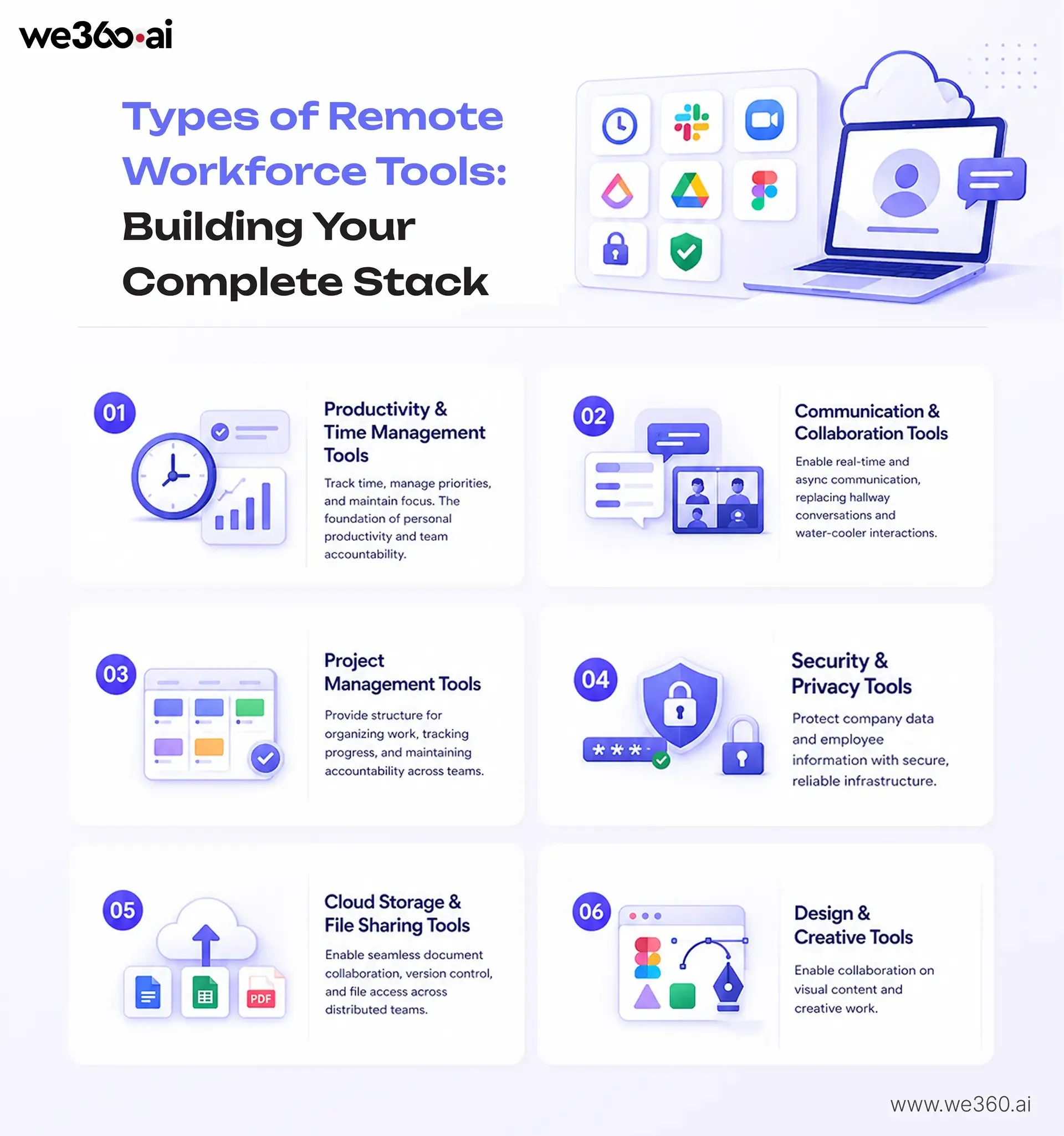
Types of Remote Workforce Tools: Building Your Complete Stack
Effective remote work tool selection requires understanding the major categories and how they work together.
1. Productivity & Time Management Tools
These time tracker tools help individuals and teams track time, manage priorities, and maintain focus. They're the foundation of personal productivity and team accountability.
Essential capabilities:
- Automatic time tracking (without surveillance)
- Task and priority management
- Focus time protection
- Productivity insights and analytics
- Integration with calendar and project management
When to use: Essential for teams where accurate time tracking matters (consulting, professional services, agencies) or where productivity insights inform management decisions. Optional for teams with strong outcome-based management.
2. Communication & Collaboration Tools
The nervous system of remote organizations. These tools enable synchronous and asynchronous communication, replacing hallway conversations and water-cooler interactions.
Essential capabilities:
- Real-time messaging (team channels and direct messages)
- Video conferencing with high-quality audio/video
- Screen sharing and recording
- Integration with other tools
- Search and message history
- Mobile access
When to use: Non-negotiable. Every remote team needs a robust communication infrastructure.
3. Project Management Tools
These AI project management tools provide a structure for organizing work, tracking progress, and maintaining accountability across teams.
Essential capabilities:
- Task creation and assignment
- Progress tracking and status visibility
- Deadline and milestone management
- Team collaboration on projects
- Custom workflows
- Reporting and insights
When to use: Critical for teams managing complex projects or coordinating across departments. Different approaches work: Kanban (Trello), hierarchical (Asana), or specialized (Jira for development).
4. Security & Privacy Tools
Non-negotiable infrastructure that protects company data and employee information.
Essential capabilities:
- Password management and secure sharing
- VPN access for secure remote connections
- Data loss prevention (DLP)
- Encryption and secure file handling
- Multi-factor authentication
- Compliance monitoring
When to use: All organizations need these. Non-negotiable, not optional.
5. Cloud Storage & File Sharing Tools
Enable seamless document collaboration, version control, and file access across distributed teams.
Essential capabilities:
- Real-time collaborative editing
- Version history and revision tracking
- Sharing and permission controls
- Offline access
- Search functionality
- Integration with productivity apps
When to use: Essential. Every remote team needs centralized, accessible file management.
6. Design & Creative Tools
For teams creating visual content, these tools enable collaboration on creative work.
Essential capabilities:
- Real-time collaborative design
- Component libraries and design systems
- Prototyping capabilities
- Version control
- Team commenting and feedback
- Integration with development tools
When to use: Critical for design, marketing, product, and creative teams. Less essential for non-creative functions.
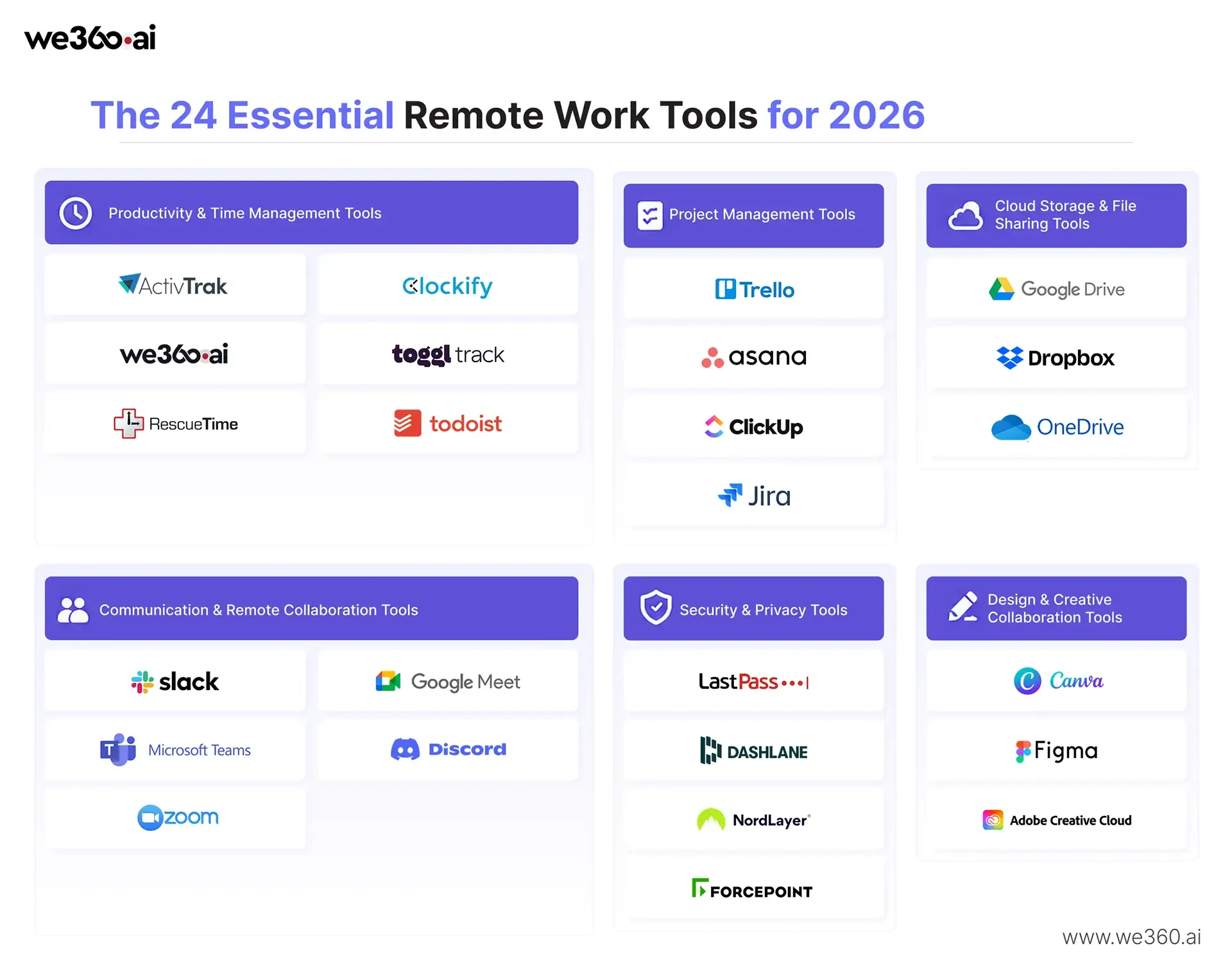
The 24 Essential Remote Work Tools for 2026
Here's a curated selection of the best remote work tools across all categories. These aren't ranked by popularity; they're evaluated on effectiveness, integration, security, and real-world team outcomes.
Productivity & Time Management Tools
1. ActivTrak – Workforce Analytics and Productivity Tracking
ActivTrak provides comprehensive workforce analytics and productivity insights without invasive surveillance. Helps teams understand work patterns, identify blockers, and optimize processes.
Best for: Organizations wanting data-driven insights into productivity and workflow optimization without the ethical issues of surveillance-focused tools.
Key features:
- Non-invasive activity categorization
- Automated productivity insights
- Team and individual dashboards
- Integration with 100+ business applications
- AI-powered anomaly detection
Pricing: Enterprise pricing; free trial available
Balances productivity insights with employee privacy. Provides actionable intelligence rather than surveillance data.
2. WE360.ai – Employee Monitoring, Productivity Insights, and Workforce Analytics
We360.ai is a comprehensive employee monitoring and workforce analytics platform that tracks productivity while providing detailed team insights and performance metrics.
Organizations prioritize visibility into remote work activity and detailed productivity analytics for compliance or management purposes.
Key features:
- Real-time activity monitoring and reporting
- Automatic time tracking
- Employee productivity scoring
- Screenshot capability (with transparency settings)
- Detailed workforce analytics and dashboards
- Integration with major time tracking and project management tools
Pricing: Tiered plans starting at ~$10/user/month
Most comprehensive monitoring and analytics capabilities. Important note: Implementation should follow strict privacy, transparency, and ethical guidelines.
Related read: The Best AI Project Management Tools in 2025
3. RescueTime – Automatic Time Tracking and Focus Insights
Automatically tracks how time is spent across applications and websites, providing individual insights without surveillance. Helps identify focus patterns and time wasters.
Optimizing individual and team productivity when privacy and trust are paramount.
Key features:
- Automatic background time tracking
- Detailed activity breakdown by category
- Focus session tracking
- Goal setting and progress tracking
- Weekly productivity reports
- Integration with Slack, Trello, and Todoist
Pricing: Free plan available; Premium at $10/month per user
Privacy-first approach. Focuses on personal productivity improvement rather than management surveillance.
4. Clockify – Free Time Tracking for Teams
Simple, free time tracking solution for teams. Track billable hours, project time, and team capacity without complexity.
Agencies, consultancies, and service organizations where accurate time tracking for billing is essential. Teams with budget constraints.
Key features:
- Free time tracking and timesheets
- Project and task-level tracking
- Team capacity planning
- Billable hours reporting
- Integration with 50+ apps
- Mobile app for field tracking
Pricing: Free for unlimited users on the basic plan; Premium at $10/user/month
Genuinely free for small teams. Simple interface with professional reporting capabilities.
5. Toggl Track – Simple and Flexible Time Tracking
Lightweight time tracking focused on simplicity and flexibility. Track time without complexity, then generate detailed reports.
Teams want straightforward time tracking without overwhelming features. Strong for freelancers and small teams.
Key features:
- One-click time tracking
- Flexible project and tag organization
- Detailed reports and analytics
- Integration with 100+ tools
- Mobile time tracking
- Team insights and dashboards
Pricing: Free plan available; Premium at $9-$199/month depending on team size
The simplest interface of major time tracking tools. Strong integration ecosystem.
6. Todoist – Task and Priority Management
Comprehensive task management system for individuals and teams. Organize work, set priorities, and track completion.
Teams and individuals need lightweight task management integrated with daily workflow.
Key features:
- Hierarchical task organization with projects and sub-tasks
- Priority levels and due date scheduling
- Recurring task automation
- Team collaboration and assignment
- 200+ integrations
- Mobile and web apps
Pricing: Free plan available; Premium at $4/month; Business at $6/month per user
Elegant interface. Exceptional integration ecosystem. Works for both individual and team task management.
Project Management Tools
Trello – Visual Task Management with Kanban Boards
Visual project management using Kanban boards. Perfect for teams preferring visual workflow organization over complex hierarchies.
Teams with simple to moderate project complexity. Marketing, product, and operations teams. Excellent for workflow visualization.
Key features:
- Kanban board interface
- Cards, lists, and boards structure
- Team collaboration and comments
- Automation with Butler
- 200+ Power-Ups for integration
- Mobile app
Pricing: Free plan available; Standard at $6/user/month; Premium at $12.50/user/month; Enterprise custom pricing
Simplest, most powerful project management tool. Low learning curve with surprising depth through Power-Ups.
8. Asana – Workflow and Team Collaboration Management
Comprehensive project management platform for complex team workflows: hierarchical project organization, timeline views, and advanced collaboration features.
Mid to large teams managing complex, multi-departmental projects. Organizations need sophisticated workflow management.
Key features:
- Hierarchical project structure (projects > sections > tasks > subtasks)
- Multiple view options (list, board, timeline, calendar)
- Advanced dependencies and milestone tracking
- Workflow templates and automation
- Portfolio management for organizational visibility
- 100+ integrations
Pricing: Free plan for small teams; $10-$24.99/user/month depending on features
Most powerful for complex workflows. Portfolio view provides organizational-level visibility that is rare among project management tools.
9. ClickUp – All-in-One Productivity Platform
Kitchen-sink productivity platform attempting to replace multiple specialized tools. Combines project management, task management, documentation, and collaboration.
Organizations want to consolidate multiple tools into one platform. Teams are comfortable with feature-rich complexity.
Key features:
- Unlimited folders, spaces, and task hierarchies
- 10+ view options (List, Board, Calendar, Gantt, and more)
- ClickUp Docs for documentation and writing
- Goals and OKR tracking
- Time tracking integration
- Custom fields and workflows
- 1000+ integrations
Pricing: Free plan available; Paid plans $5-$19/user/month
Most customizable. Ambitious feature set. It can genuinely replace multiple specialized tools for organizations willing to invest in optimization.
10. Jira – Agile Project Management for Development Teams
Industry-standard project management tool for software development teams. Optimized for agile methodologies and development workflows.
Software development teams. Organizations using Scrum, Kanban, or other agile methodologies. Any team needing specialized development workflow management.
Key features:
- Sprints, story points, and velocity tracking
- Agile board (Scrum and Kanban)
- Backlog management
- Reporting (burndown, velocity, release)
- Developer integration (GitHub, GitLab, Bitbucket)
- Advanced customization for development workflows
- Server and Cloud deployment options
Pricing: Cloud-based at $7-$14/user/month; Server/Data Center custom pricing
Market leader for development teams. Integrates seamlessly with development tools. Provides insights specific to engineering workflows.
Communication & Remote Collaboration Tools
Slack – Team Messaging and Integrations
Real-time team messaging platform replacing email for internal communication. Organize conversations by channel and enable direct messaging.
Organizations are moving toward modern internal communication. Essentially universal for distributed teams.
Key features:
- Channel-based organization of conversations
- Direct messaging and group conversations
- Search across message history
- 2000+ app integrations
- Workflow Builder for automation
- Video and screen sharing
- Mobile and desktop apps
Pricing: Free plan available; Pro at $8.99/user/month; Business+ at $12.50/user/month; Enterprise Grid custom pricing
Market standard for internal communication. An exceptional integration ecosystem enables connection with virtually any business tool.
12. Microsoft Teams – Enterprise Communication Hub
Integrated communication and collaboration platform combining messaging, video conferencing, and file collaboration within the Microsoft 365 ecosystem.
Organizations are already invested in Microsoft 365. Enterprises valuing integrated security and governance. Organizations requiring tight Office integration.
Key features:
- Teams channels and direct messaging
- Integrated video conferencing (up to 300 participants)
- File sharing with Office document collaboration
- OneNote and SharePoint integration
- Team apps and custom integrations
- Meeting recording and transcription
- Governance and compliance features
Pricing: Included with Microsoft 365 subscriptions; Standalone plans available
Deepest integration with the Microsoft 365 ecosystem. Strong security and governance for enterprise organizations.
13. Zoom – Video Conferencing and Webinars
Market-leading video conferencing platform—industry standard for remote meetings, webinars, and virtual events.
Remote teams need reliable video conferencing. Organizations hosting webinars and large virtual events. Any team prioritizing meeting quality.
Key features:
- HD video conferencing (up to 1000 participants)
- Screen sharing and annotation
- Breakout rooms for group work
- Meetings recording and transcription
- Webinar capability with up to 10,000 attendees
- Integration with calendar and productivity tools
- Zoom Rooms for conference room integration
Pricing: Free plan (40-minute limit); Pro at $16.99/month; Business at $26.99/month; Enterprise custom pricing
Most reliable video platform. Best-in-class meeting quality. Dominant market share.
14. Google Meet – Seamless Video Meetings Within the Google Ecosystem
Video conferencing is integrated within Google Workspace. Embedded in Gmail, Calendar, and Google apps for seamless meeting access.
Organizations using Google Workspace (especially education and non-profits). Teams valuing integration with Google tools.
Key features:
- Video conferencing with up to 300 participants
- Integrations with Gmail and Google Calendar
- Real-time captions and translation
- Screen sharing and presentation sharing
- Recording to Google Drive
- Mobile app for video calls
- Grid view and speaker view options
Pricing: Free plan available; Included with Google Workspace for Business plans and higher
Deepest integration with Google Workspace. No additional login required. Strong international transcription and translation.
15. Discord – Informal Team Communication and Voice Channels
Chat and voice platform originally designed for gaming communities, increasingly used by remote teams for informal communication and voice coordination.
Teams want voice-first communication options. Tech-focused organizations. Teams where voice is preferred over text.
Key features:
- Voice and text channels
- Always-on voice channels (no need to schedule/join)
- Screen sharing and streaming capability
- Low-latency communication
- Community management features
- Bots and integrations
- Mobile and desktop apps
Pricing: Free plan available; Discord Nitro at $9.99/month (cosmetic features mostly)
Most natural voice communication platform. Always-on channels reduce meeting friction. Free for most use cases.
Cloud Storage & File Sharing Tools
Google Drive – Real-Time File Sharing and Collaboration
Cloud storage with real-time collaborative editing for documents, spreadsheets, and presentations. The foundation of Google Workspace collaboration.
Organizations using Google Workspace. Teams value real-time collaborative editing. Non-profit and education organizations.
Key features:
- Cloud storage with desktop sync
- Real-time collaborative editing (Docs, Sheets, Slides)
- Sharing and permission controls
- Version history and commenting
- Offline editing capability
- 200+ integrations with third-party apps
- Advanced search capabilities
Pricing: Free plan (15GB); Google One at $1.99-$9.99/month (100GB-2TB); Included with Google Workspace plans
Most seamless collaborative editing experience. Free tier is genuinely useful. Integrations are extensive.
Dropbox – Secure File Storage and Syncing
Cloud storage platform with a focus on file syncing, sharing, and team collaboration—Platform-agnostic across Windows, Mac, Linux, iOS, and Android.
Organizations need platform-agnostic cloud storage. Teams where file sync matters as much as collaboration—organizations with specific compliance requirements.
Key features:
- Cloud storage with desktop syncing
- File sharing with granular permissions
- Shared workspaces for team collaboration
- Version history and recovery
- Dropbox Sign for e-signature workflows
- Integration with 600+ apps
- Advanced security and compliance features
Pricing: Free plan (2GB); Dropbox Standard at $11.99/month; Dropbox Plus at $19.99/month; Dropbox Family at $19.99/month; Business plans starting at $16.99/user/month
Reliable sync engine. Platform-agnostic. Strong security and compliance features.
OneDrive – Microsoft-Integrated Cloud Storage
Microsoft's cloud storage platform. Tightly integrated with Windows, Microsoft 365 apps, and Windows 10/11.
Organizations using Microsoft 365. Windows-centric organizations. Teams valuing deep Office app integration.
Key features:
- Cloud storage with Windows integration
- Real-time collaborative editing with Microsoft 365 apps
- SharePoint integration for team sites
- Sharing and advanced permissions
- Version history and recovery
- Mobile apps
- Advanced security features
Pricing: Included with Microsoft 365 subscriptions; OneDrive standalone at $1.99-$9.99/month for personal storage
Deepest Office integration. Included with Microsoft 365. Strong Windows integration.
Security & Privacy Tools
19. LastPass – Password Management
A password manager that securely stores and autofills login credentials. Reduces password fatigue and improves security.
Teams need secure password management. Organizations where employees manage 50+ passwords. Small to mid-sized organizations.
Key features:
- Secure password storage and autofill
- Password generation with customizable rules
- Sharing passwords securely with team members
- Multi-factor authentication support
- Browser extensions (Chrome, Firefox, Safari, Edge)
- Mobile apps
- Emergency access for designated contacts
Pricing: Free plan available; LastPass Premium at $3/month; LastPass Teams at $4/user/month; LastPass Enterprise custom pricing
Simple, reliable interface. Strong security. Good team sharing capabilities for the price.
20. Dashlane – Secure Password Vault with Monitoring
Premium password manager with comprehensive security monitoring and dark web surveillance. More feature-rich than basic password managers.
Security-conscious teams. Organizations prioritize comprehensive password security and breach detection.
Key features:
- Secure password storage and management
- Dark web monitoring for leaked passwords
- Automatic password change (for supported sites)
- Digital wallet for payment information
- Emergency access features
- Security breach alerts
- VPN included with premium plans
Pricing: Premium at $4.99/month; Teams at $7.99/user/month; Business plans custom pricing
Most comprehensive password security. Dark web monitoring catches compromised passwords. Team management is straightforward.
21. NordVPN / NordLayer – Secure Remote Access via VPN
A VPN service provides encrypted remote access and privacy protection. NordLayer is specifically designed for business teams.
Organizations with remote workers need secure access to company resources, and teams prioritize privacy and security.
Key features for NordLayer:
- Military-grade encryption for remote connections
- Automatic kill switch (disconnects the internet if VPN fails)
- Double VPN encryption option
- Dedicated IP addresses available
- Team management and centralized control
- 24/7 support
Pricing: NordVPN at $3.99-$12.99/month; NordLayer business plans starting at $7.99/user/month
Strong security reputation. NordLayer is specifically designed for business—reliable encryption for remote workers.
Forcepoint DLP – Data Protection and Compliance
A data loss prevention (DLP) platform that protects sensitive information, prevents unauthorized data sharing, and ensures compliance.
Organizations handling sensitive data. Regulated industries (healthcare, finance, legal). Large enterprises require comprehensive data security.
Key features:
- Real-time data loss prevention
- File and email monitoring
- Endpoint DLP protection
- Cloud service monitoring
- Compliance reporting (GDPR, HIPAA, PCI-DSS)
- User behavior analytics
- Incident response and reporting
Pricing: Enterprise custom pricing
Most comprehensive enterprise DLP solution. Handles complex compliance requirements.
Design & Creative Collaboration Tools
Canva – Easy Graphic Design for Teams
A web-based design platform making graphic design accessible to non-designers—an extensive template library for quick design creation.
Marketing, social media, and communications teams. Organizations without dedicated design resources. Rapid content creation needs.
Key features:
- 10,000+ templates for various formats
- Drag-and-drop design interface
- Brand kit for consistent brand elements
- Team collaboration and approval workflows
- Integrations with social media platforms
- Stock photos and design elements
- Mobile app for creation
Pricing: Free plan available; Canva Pro at $13/month; Canva Teams at $30/month for up to 5 people; Canva Enterprise custom pricing
Most accessible design tool. Extensive templates eliminate design knowledge requirements. Team collaboration is intuitive.
Figma – UI/UX Design and Collaboration
Cloud-based design and prototyping tool built for collaboration. Industry standard for product design and design systems.
Design and product teams. Organizations building design systems. Companies are prioritizing collaborative design processes.
Key features:
- Real-time collaborative design interface
- Prototyping and interactive components
- Design systems and component libraries
- Developer handoff with inspect mode
- Version history and branching
- Comments and design review
- Mobile design app
- Plugins extending functionality
Pricing: Free plan (limited files); Professional at $12/editor/month; Organization custom pricing
Most natural collaborative design tool. Developer integration is superior. Design systems management is mature.
Adobe Creative Cloud – Advanced Design and Creative Suite
Industry-standard suite of creative applications. Photoshop, Illustrator, InDesign, After Effects, and others.
Professional designers and creative studios. Organizations require professional-grade creative tools. Teams need specialized creative applications.
Key features:
- Full professional creative suite (20+ applications)
- Cloud collaboration and asset management
- Mobile apps extending capabilities
- Extensive plugin ecosystem
- One-click sharing and feedback
- Libraries for asset management
Pricing: Single app at $20.49/month; All apps (Creative Cloud) at $54.49/month; Teams at $55/month per user; Enterprise custom pricing
Industry standard. Most comprehensive feature set. Seamless integration across applications.
How to Build the Right Remote Work Tech Stack: A Strategic Framework
Having 24 tools means nothing without a strategic approach to implementation. Here's how leading organizations build effective tech stacks.
Avoid Tool Overload: Focus on Integration
The single biggest mistake organizations make is tool proliferation. Different departments choose different tools, creating silos and reducing overall effectiveness.
The principle: Choose fewer tools that integrate deeply rather than more tools that work in isolation.
For a typical organization, a robust stack includes:
- 1-2 communication platforms (typically Slack or Teams)
- 1-2 project management tools (depending on complexity)
- 1 file storage solution (Google Drive or OneDrive if using Microsoft, Dropbox otherwise)
- 1 design tool (Figma for design teams, Canva for content creation)
- Foundational security and analytics (password manager, VPN, productivity insights)
- Specialized tools for specific functions (industry-specific or role-specific)
Evaluate every new tool against: "Does this integrate with our existing stack? Does it solve a specific problem we're actually experiencing?"
Combine Productivity + Collaboration + Security Tools
An effective stack isn't about having the most tools; it's about having the right combination of complementary tools.
The three pillars:
Pillar 1: Collaboration & Communication
- Central hub (Slack or Teams)
- Video platform (Zoom or Google Meet)
- File storage (Google Drive or OneDrive)
Pillar 2: Productivity & Project Management
- Project management (Trello, Asana, Jira, or ClickUp, choose one based on complexity)
- Task management (Todoist for lightweight needs)
- Time tracking if needed (Clockify, Toggl, or RescueTime)
Pillar 3: Security & Analytics
- Password management (LastPass or Dashlane)
- VPN for remote access (NordLayer)
- Productivity analytics (ActivTrak or WE360.ai for insights)
- DLP if handling sensitive data (Forcepoint)
This three-pillar structure ensures comprehensive coverage without tool sprawl.
Align Tools with Business Goals and Workflows
The best tool for another company isn't necessarily the best tool for you. Alignment with your specific workflows is critical.
Evaluation process:
- Map current workflows: Document how work actually flows through your organization
- Identify bottlenecks: Where do delays, rework, or miscommunication occur?
- Define success metrics: How will you measure tool effectiveness? (productivity, collaboration quality, employee satisfaction, cost)
- Evaluate candidates: Test finalists with actual use cases from your workflows
- Plan transition: How will you migrate from current systems to new tools?
- Measure outcomes: Track metrics defined in step 3 for 3 months post-implementation
Companies that follow this disciplined approach achieve 85% faster ROI than those adopting tools reactively.
Train Teams for Maximum Adoption
Tools only create value when used effectively. Training and enablement are non-negotiable.
Adoption strategy:
- Executive sponsorship: Leadership must visibly use new tools
- Train-the-trainer program: Develop internal champions who help peers
- Hands-on training sessions: Don't rely on self-directed learning
- Documented best practices: Create team-specific workflows and guidelines
- Ongoing support: Dedicate resources to questions and optimization
- Regular check-ins: Monitor adoption and adjust training as needed
Teams that receive structured adoption support achieve 43% higher usage and 34% faster productivity gains.
Continuously Optimize Based on Usage Data
Implementation isn't the endpoint; it's the beginning. Successful organizations continuously optimize their stacks.
Optimization approach:
- Monitor adoption metrics – Are teams using tools as intended?
- Gather user feedback – What's working? What's frustrating?
- Identify integration gaps – Are tools communicating effectively?
- Track productivity impact – Are you seeing expected productivity gains?
- Quarterly reviews – Assess performance against success metrics
- Iterate and improve – Remove underutilized tools, optimize strong performers
Organizations optimizing quarterly report 23% better outcomes than those implementing once and moving on.
We360.ai: The Best Employee Monitoring & Workforce Analytics Tool for Remote Teams
Among the 24 tools discussed, WE360.ai deserves special attention as a comprehensive solution for organizations prioritizing visibility and workforce analytics.
Why WE360.ai Stands Out
Comprehensive monitoring and analytics – WE360.ai combines employee monitoring with sophisticated workforce analytics, providing organizations with deep insights into remote work patterns and productivity.
Transparency and customization – Unlike surveillance-focused tools, WE360.ai enables organizations to configure monitoring in ways that respect privacy while providing necessary insights. Screenshot frequency, monitoring scope, and reporting can all be customized.
Integration ecosystem – Seamless integration with leading project management (Asana, Monday, Jira), communication (Slack, Teams), and time tracking tools creates a connected workforce analytics environment.
Actionable insights – Raw monitoring data becomes actionable through AI-powered analytics. Identify productivity patterns, team dynamics, and performance trends without manual analysis.
Compliance and governance – Built-in compliance features address GDPR, CCPA, and other privacy regulations. Audit logs and access controls ensure proper data governance.
Related read: Top 7 Workforce Analytics Tools in 2025
Implementation Best Practices
Transparency first – Communicate clearly with employees about monitoring. Explain how data is used and what benefits they receive.
Focus on improvement, not surveillance – Frame insights as ways to help teams work better, not as tools to police employees.
Privacy by default – Configure WE360.ai with the minimum monitoring necessary to achieve your goals. Respect employee privacy by default.
Balance monitoring with trust – Combine monitoring insights with strong outcome-based management. Good management is more important than surveillance data.
Regular reviews – Quarterly assess what you're learning from WE360.ai and whether it justifies the investment.
Conclusion: Your Tech Stack Is Your Competitive Advantage
The difference between high-performing remote teams and struggling ones often comes down to technology infrastructure.
It's not about having the most tools. It's about having a thoughtfully assembled tech stack in which each tool serves a specific purpose, integrates seamlessly with others, and amplifies the team's capabilities.
The 24 remote work tools outlined here represent the current frontier of what's possible in distributed work environments. Productivity and time-management tools help individuals stay focused. Communication and collaboration tools enable seamless connection. Project management tools provide structure. Security tools protect what matters. Design tools enable creativity.
Together, these tools create an environment where remote teams can collaborate effectively, maintain focus, and achieve results that rival or exceed traditional office environments.
The organizations winning in 2026 aren't those throwing random tools at problems. They're strategically investing in thoughtfully chosen remote workforce tools, integrating them deliberately, training their teams properly, and continuously optimizing based on outcomes.
Your tech stack isn't overhead, it's an investment in your team's capability and your organization's future.
Frequently Asked Questions
What Are the Best Remote Work Tools in 2026?
The best remote work tools depend on your specific needs, but a comprehensive stack includes: Communication (Slack or Microsoft Teams), Video conferencing (Zoom), Project management (Asana or Jira), File storage (Google Drive or OneDrive), Time tracking (Clockify or RescueTime), Password management (LastPass), Design (Figma or Canva), and Analytics (ActivTrak or WE360.ai).
Which Tools Improve Remote Team Productivity?
The highest-impact tools for productivity are: (1) Time tracking tools that provide visibility and reduce distraction, (2) Project management tools that clarify work and reduce coordination overhead, (3) Communication platforms that reduce email and meetings, (4) Automation tools that eliminate manual work, and (5) Analytics tools that identify workflow bottlenecks.
Teams using integrated stacks of these tools report productivity improvements of 30-40%.
What Are the Best Collaboration Tools for Remote Teams?
Top collaboration tools include: Slack or Microsoft Teams for communication, Asana or ClickUp for project management, Google Drive or OneDrive for file collaboration, Figma for design collaboration, and Zoom or Google Meet for video. The key is choosing tools that integrate well and match your team's work style.
Are Remote Work Tools Secure?
The best remote work tools implement enterprise-grade security (encryption, SOC 2 compliance, audit logging), but security is a spectrum. Evaluate tools on their security certifications, compliance frameworks, encryption standards, and incident response procedures. Always complement tool security with strong organizational practices (access controls, authentication, training).
How Many Tools Should a Remote Team Use?
Avoid excessive tool proliferation. A typical organization should use 7-12 core tools: 1-2 communication platforms, 1-2 project management tools, 1 file storage solution, 1-2 specialized tools (design, time tracking), and 2-3 security/analytics tools. Beyond this, each additional tool adds complexity that typically outweighs benefits.
The goal isn't to have the most tools; it's to have the right tools in the right combination.
Related Posts
Employee attendance and tracking are changing as workplaces become more flexible and distributed. This guide looks at how businesses are using modern technology to manage attendance, work hours, remote teams, and productivity. Learn about emerging trends, practical tools, and better ways to track work while keeping processes simple and transparent.

Learn what time theft means, how it happens, and why it matters to businesses. Explore common examples such as inaccurate time reporting, extended breaks, buddy punching, and unauthorized activities. Understand how companies detect time theft using attendance systems, time tracking, and productivity tools while maintaining transparency, fairness, and employee trust.

Employee perks can be valuable for both employees and employers when planned thoughtfully. This guide explores how to choose benefits that employees actually value while keeping business goals and budgets in mind. Learn how the right perks can improve satisfaction, engagement, retention, productivity, and workplace culture without unnecessary spending.

Learn the common signs that your workplace may be monitoring employee activity and what this means for privacy, transparency, and trust. Understand different types of workplace monitoring, why employers use them, how monitoring can affect employees, and how businesses can create fair, transparent policies that balance productivity with employee trust.