
Ask whether remote employees are more productive and you'll get two confidently opposite answers depending on who you ask. CEOs point to declining collaboration and quiet offices. Employees point to years of data showing they get more done at home. Both sides can cite real numbers. That's exactly why this question deserves a straight answer instead of another advocacy piece for one side.
The short answer: remote work modestly increases productivity when structured as hybrid or randomly assigned, but fully remote arrangements chosen by self-selected employees tend to underperform hybrid setups — and the apparent contradiction in the data mostly comes down to how each study was actually conducted, not whether remote work "works."
The Strongest Evidence: What Randomized Studies Actually Found
The single most credible piece of evidence in this entire debate is Stanford economist Nicholas Bloom's randomized controlled trial at Ctrip (now Trip.com). Employees were randomly assigned — not allowed to choose — either to work from home or stay in the office. This matters enormously, because random assignment removes the possibility that only the most disciplined or motivated employees ended up working remotely. The result: employees assigned to work from home completed roughly 13 to 13.5% more work than their office-based peers, with the gain driven mostly by longer effective working time and fewer interruptions rather than working faster minute-to-minute.
A later follow-up study by the same research team looked at hybrid arrangements specifically — employees working from home two days a week. Those hybrid workers were found to be just as productive and just as likely to be promoted as fully office-based peers, while voluntary resignations dropped by roughly a third. This is arguably the most important finding in the entire debate: hybrid, not full remote, is where the rigorous evidence is strongest and most consistent.
The Complicating Evidence: Why Some Data Shows the Opposite
Here's where the picture gets genuinely more nuanced, and where a lot of "remote work doesn't work" arguments actually come from real data rather than pure opinion.
Self-selected full-remote workers show a different pattern than randomly assigned ones. When employees choose to work fully remote themselves — rather than being randomly assigned as in Bloom's original study — that group has shown productivity roughly 10 to 20% lower than hybrid workers, largely attributed to more distractions at home and fewer social accountability cues. This is a genuinely important distinction: it's not that remote work itself reduces output, it's that a self-selected "who wants to go fully remote" population is a different group of people with different work habits than a randomly assigned one.
Novelty effects fade. Some of the earliest and most optimistic remote-work productivity data came from the initial shift to remote work, when companies including Microsoft, Splunk, and Affirm saw productivity spikes in the first months that gradually declined as isolation set in. A study measured six months into a shift looks very different from one measured at eighteen months.
Isolation and communication overload carry real, if less visible, costs. Roughly a quarter of fully remote employees report meaningful loneliness, and burnout affects close to half of all knowledge workers regardless of location. The default corporate response to remote/hybrid friction — more meetings, more Slack messages, more check-ins — often makes this worse rather than better, quietly eating into the productivity gains from fewer commute-related interruptions.
So What Does the Data Actually Say, Combined?
Putting the rigorous evidence together rather than picking a side:
- Randomly assigned remote work: modestly more productive — Bloom's Ctrip trial found roughly a 13% gain, and a Bureau of Labor Statistics analysis across 61 industries found a positive association between remote work adoption and total factor productivity growth (a 1 percentage point increase in remote adoption tracked with a 0.08-0.09 point increase in productivity growth, holding after controlling for pre-pandemic trends).
- Hybrid (roughly 2-3 days remote): the most consistently strong result — equally productive and equally promotable as full in-office work, with meaningfully lower voluntary turnover. Across multiple 2026 datasets, hybrid has become the dominant model for exactly this reason.
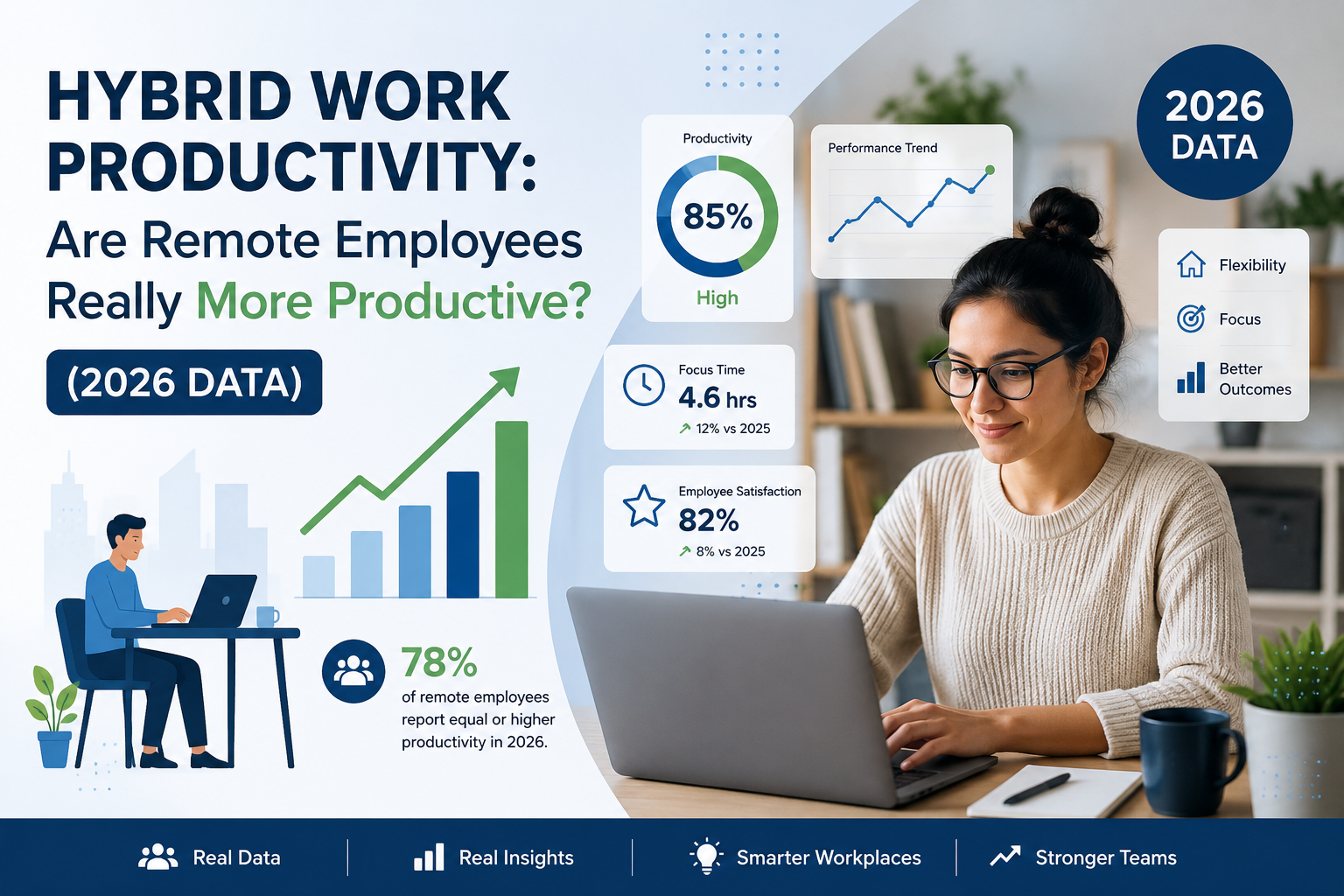
- Fully remote, self-selected: mixed, and often lower than hybrid — self-reported productivity is high (77% of remote employees say they're more productive at home), but when studies control for self-selection, fully remote workers underperform hybrid workers by a meaningful margin, driven by isolation and reduced accountability rather than the remote setup itself.
- Fully in-office, full-time: no clear productivity advantage in the current data — despite high-profile five-day mandates from companies like Amazon, Dell, JPMorgan Chase, and the U.S. federal government, the productivity case for full-time office work isn't well supported by the rigorous evidence; the argument for it tends to rest on collaboration and culture rather than measured individual output.
What This Means for How You Should Actually Read This Debate
The apparent contradiction — "remote workers are more productive" versus "remote work productivity is declining" — mostly dissolves once you separate three different things that get lumped together in casual reporting: how the study measured people (random assignment versus self-selection versus self-report), how long after the shift the measurement happened (early novelty versus settled-in patterns), and what specific arrangement was tested (fully remote versus hybrid versus full in-office).
The most defensible, data-backed position for 2026 is not "remote is better" or "office is better" — it's that structured hybrid arrangements, with real accountability and genuine in-person collaboration on the days people are together, consistently outperform both extremes in the highest-quality evidence available.
Frequently Asked Questions
Are remote employees more productive than in-office employees? The most rigorous evidence, based on randomized controlled trials, shows remote work modestly increases productivity, with Stanford's Ctrip study finding roughly a 13% gain. However, self-selected fully remote workers (as opposed to randomly assigned ones) have shown lower productivity than hybrid workers in some studies, so the answer depends heavily on how the work arrangement is structured.
Why do some studies say remote work reduces productivity? This is usually driven by self-selection bias (employees who choose full remote work differ from those randomly assigned to it), novelty effects fading over time as isolation sets in, or measurement based on self-selected fully remote cohorts rather than hybrid or randomly assigned arrangements, which show consistently stronger results.
Is hybrid work more productive than fully remote or fully in-office work? Current evidence suggests hybrid arrangements, typically two to three days remote per week, produce the most consistently positive results — matching in-office productivity and promotion rates while reducing voluntary turnover by roughly a third compared to fully in-office schedules.
What is the Stanford remote work study everyone cites? It refers to Nicholas Bloom's randomized controlled trial at Ctrip (now Trip.com), where call center employees were randomly assigned to work from home or stay in the office. Those working from home completed about 13 to 13.5% more work, primarily due to longer effective working time and fewer interruptions.
Does remote work increase employee burnout or loneliness? Yes, to a meaningful degree. Roughly a quarter of fully remote employees report meaningful loneliness, and burnout affects close to half of all knowledge workers regardless of location, which is why isolation-related costs need to be weighed against the productivity gains remote work can produce.