
Hybrid work has moved from pandemic experiment to permanent fixture — but the details (how many days, who decides, and whether it actually works) are still hotly debated. The data, however, tells a remarkably consistent story.
Here are 12 of the most important hybrid work statistics for 2026, drawn from authoritative sources like Gallup, Stanford, the U.S. Bureau of Labor Statistics, Robert Half, and Owl Labs — with what each one means for employers and employees.
Note: figures reflect the most recent reporting available in 2026. Always confirm the latest numbers with the original source before citing them formally.
Is hybrid work still growing in 2026?
Yes — hybrid work is now the dominant model for remote-capable employees, and the data shows it has stabilized as a permanent structural shift rather than a temporary trend. Adoption has leveled off at a high plateau, employee preference remains overwhelming, and productivity research has largely settled in hybrid's favor. The open questions are now about how to do hybrid well, not whether to offer it.
12 Hybrid Work Statistics for 2026
1. Hybrid is the dominant arrangement for remote-capable workers
According to Gallup, among remote-capable U.S. employees, around 53% work hybrid, 27% work fully remote, and only about 20% are fully on-site. That means roughly eight in ten knowledge workers now have some form of location flexibility — a fundamental and durable shift away from the five-day office norm.
2. The "3-2" model has become the default
Industry surveys in 2026 show that roughly 76% of companies use a hybrid approach, most commonly the "3-2" model — three days in the office, two days remote. Among organizations with formal policies, about two-thirds require at least three in-office days per week, making mid-week presence the new standard.
3. Tuesday–Thursday is the new office week
Building-access data from Kastle Systems across thousands of buildings shows a clear "barbell" pattern: Tuesday, Wednesday, and Thursday are consistently the busiest office days, with mid-week occupancy roughly double that of Monday and Friday. Employees concentrate collaboration mid-week and reserve Mondays and Fridays for focused remote work.
4. Most U.S. employers offer some flexibility
Robert Half research found that around 88% of U.S. employers now offer at least some hybrid options, though about 25% extend hybrid work to all employees. Flexibility has become a baseline expectation rather than a perk, even as access still varies by role and seniority.
5. Employees overwhelmingly prefer hybrid
Across multiple 2026 surveys, roughly 83% of workers say they prefer a hybrid arrangement combining remote and in-office days — making it by far the most popular model across industries, seniority levels, and demographics. The preference is global, not just a U.S. phenomenon.
6. Workers value flexibility at about 8% of salary
Research from Stanford economist Nicholas Bloom and colleagues (the SWAA survey) found that the average employee values the ability to work from home two to three days a week at roughly 8% of their salary — meaning they'd accept about 8% less pay to keep it. That's a substantial "flexibility premium" employers can use to attract talent without raising compensation.
7. Rigid return-to-office mandates drive attrition
SurveyMonkey's 2026 workforce research found that about 29% of remote and hybrid employees would consider leaving if forced back to the office full-time. Other surveys put the figure higher among younger workers — a clear signal that aggressive RTO mandates carry a real retention cost.
8. Hybrid work improves retention
Stanford and Nature research found that shifting from full-time office attendance to a hybrid schedule reduced resignations by about 33%, with no damage to performance. For employers, hybrid work can pay for itself in retention savings alone.
9. Hybrid teams are at least as productive — often more
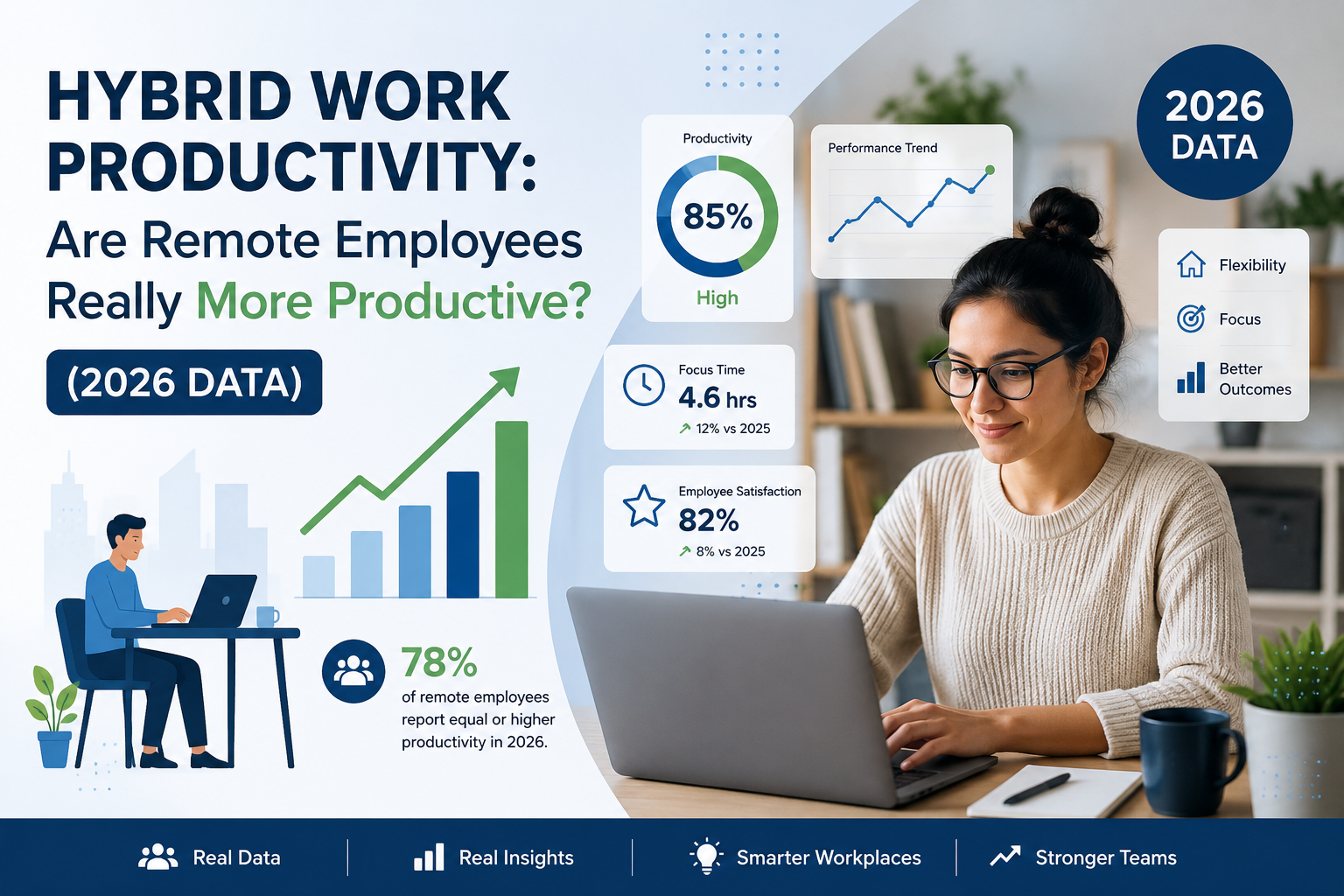
The productivity debate has largely been settled. Stanford/Nature research found well-organized hybrid teams to be roughly 5% more productive than fully in-office teams, and the majority of employees and managers report equal or higher productivity under flexible arrangements. The "productivity loss" fear isn't supported by the data.
10. Hybrid work delivers major real-estate savings
Research cited by CBRE and Global Workplace Analytics indicates companies can save anywhere from 10% to 50% on office-space costs by shifting to hybrid, with average savings of around $11,000 per year for each employee working remotely two to three days a week. Flexibility is a cost lever, not just a culture one.
11. Burnout and "always-on" pressure remain real risks
Despite the benefits, around a third of workers report feeling burned out regardless of where they work, and hybrid employees often log the longest average workdays — partly because remote work blurs the line between work and personal time. Flexibility helps work-life balance, but boundary management still matters.
12. "Productivity paranoia" is pushing some leaders toward RTO
A persistent trust gap remains: many leaders report struggling to trust productivity they can't see, a phenomenon often called "productivity paranoia" that drives some RTO pushes. Yet the data shows this concern is largely unfounded — and that the answer is better visibility into outcomes, not forcing people back to desks.
What do these hybrid work statistics tell us?
Taken together, the 2026 data delivers a consistent message: hybrid work is permanent, overwhelmingly preferred, and productivity holds up or improves — while the main risks are burnout and a trust gap, not lost output. Companies still pushing for full-time office attendance are working against nearly every major data point.
The recurring theme behind the numbers is trust and visibility. Employees want flexibility and are more productive with it; leaders worry because they can't easily see how remote work is going. The organizations that win are the ones that close that gap with better measurement, not more mandates.
Frequently asked questions
What percentage of workers are hybrid in 2026? Among remote-capable U.S. employees, around 53% work hybrid, 27% are fully remote, and about 20% are fully on-site, according to Gallup. That's roughly eight in ten knowledge workers with some location flexibility.
Is hybrid work more productive than office work? The research largely says yes or at least equal. Stanford/Nature research found well-organized hybrid teams about 5% more productive than fully in-office teams, and most employees and managers report equal or higher productivity with flexibility.
How many days do hybrid workers go to the office? The most common pattern is the "3-2" model — three days in the office, two remote — with Tuesday through Thursday being the busiest office days. Average in-office requirements have been rising toward three days for many companies.
Do return-to-office mandates cause people to quit? The data suggests yes for a meaningful share. Surveys show roughly 29% of remote/hybrid employees would consider leaving if forced fully back to the office, with higher figures among younger workers.
What's the biggest downside of hybrid work? The main risks are burnout and blurred work-life boundaries — hybrid workers often log the longest days — plus a "productivity paranoia" trust gap among leaders who can't easily see remote work happening.
The thread behind the data: visibility, not surveillance
Look across these statistics and one tension keeps surfacing: employees are more productive with flexibility, yet many leaders struggle to trust what they can't see — and that "productivity paranoia" is what fuels heavy-handed RTO mandates the data doesn't support.
The solution isn't forcing people back to desks; it's better visibility into how work actually happens. Workforce analytics platforms like We360.ai give leaders a clear, trend-level view of productivity and workload across hybrid and remote teams — closing the trust gap with objective insight rather than mandates or surveillance. Used transparently, that's how organizations get the retention and cost benefits of hybrid work and the confidence that it's working.
Conclusion
The 2026 hybrid work statistics point in one direction: flexible work is here to stay, it's what employees want, and it doesn't cost productivity. The real challenges are managing burnout and bridging the trust gap between leaders and distributed teams.
The organizations that thrive in this environment won't be the ones with the strictest office mandates — they'll be the ones that embrace flexibility and build the visibility to manage it well.
Sources referenced include Gallup, Stanford WFH Research (Nicholas Bloom et al.) and Nature, the U.S. Bureau of Labor Statistics, Robert Half, Owl Labs, SurveyMonkey, Kastle Systems, CBRE, and Global Workplace Analytics. Figures reflect 2026 reporting; confirm the latest data with each original source before formal use.