
The true measure of a high-performing employee goes beyond output. It lies in the behavior of employee patterns that consistently drive results. While metrics like deadlines and deliverables offer surface-level insights, it’s the underlying work behaviors and daily actions that reveal who your real top performers are.
As per stats:
- High performers can contribute up to 61% of a team’s total output, making them significantly more valuable than average employees.
- Around 20% of employees generate nearly 60% of total productivity, reinforcing the importance of identifying top talent early.
- Teams with strong engagement (a key trait of high performers) experience:
- 78% lower absenteeism
- Fewer errors and higher consistency in output
In today's dynamic workplace, you need to look more deeply at performance characteristics such as ownership, collaboration, adaptability, and critical thinking. These traits not only influence individual success but also shape team productivity, culture, and long-term business growth. Recognizing the right performance characteristics early allows organizations to nurture talent, reduce attrition, and build a strong leadership pipeline.
Let’s dive into why it’s crucial to identify top-performing employees.
Identify High-Performing Employees: Understand Why It Matters
Drives overall team productivity
According to a McKinsey report, improved collaboration and communication within a team raises employee productivity by 20 to 25%. The way high-performing employees interact with each other greatly contributes to solving problems and achieving goals. Research published in the Journal of Applied Psychology finds that employees who engage in decision-focused conflict and problem-solving demonstrate improved team performance.
Reduces employee turnover
A 2022 survey conducted by FlexJobs, involving 2,202 respondents, found that the top reasons employees consider leaving their jobs include toxic workplace culture (62%), inadequate compensation (59%), ineffective management (56%), and an unhealthy work-life balance (49%). When you cater to high-performing employees and take care of their well-being, it reduces turnover.
Helps in leadership development
A high-potential employee program provides a clear roadmap for identifying future leaders with ambition to grow. These high-performing employees, or your HiPos, are quite possibly your competitive advantage. You may think you’re keeping your HiPOs busy by assigning them work, but the hard reality is you’re just on the brink of losing them. A pivotal role in keeping your employees engaged is to involve them in strategic discussions to foster trust and influence team dynamics.
Improves hiring decisions
Research shows HiPOs are 400% more effective than an average employee. The question is how to find out and retain HiPOs when they constitute less than 20% of your workforce. You can take the first step by making your organization a brand. Then craft the right job description and emphasize culture, values, and perks.
Research by Harvard Business Review states HiPOs are attracted by high base salaries and competitive bonus schemes. They are tied to individual performance, retirement plans, and L&D programs.
Key High-Performance Employee Behaviors to Look For
Let’s understand high-performance employee behaviors to scan:
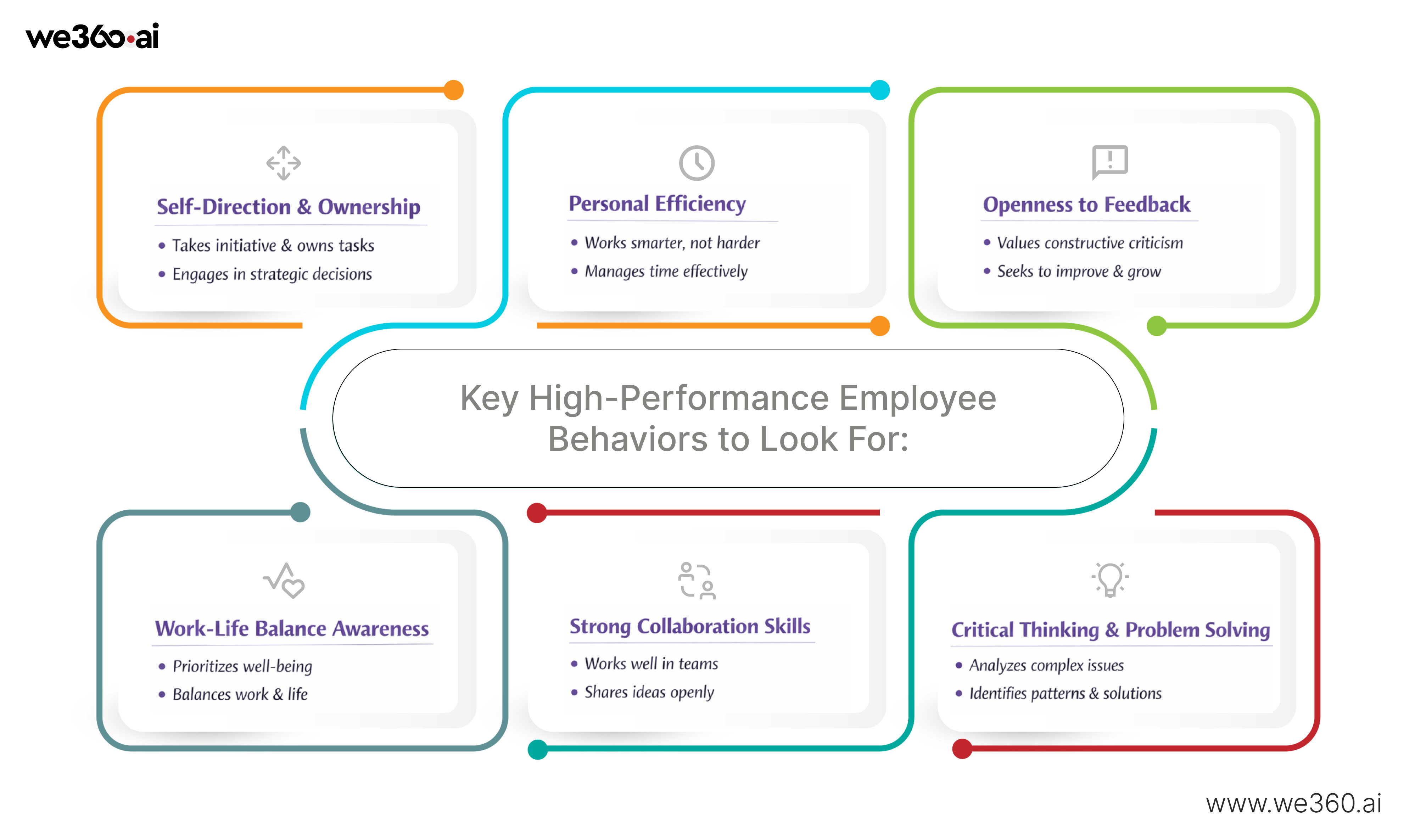
Self-Direction and Ownership
The findings indicate that self-directed employees foster a stronger culture of knowledge sharing and strategies and build greater mutual trust among team members.
They take ownership and accountability for their tasks. Additionally, they take the initiative, delve into strategic decisions, and make suggestions as needed.
Personal Efficiency
Your top-performing employees work smarter than being hard on themselves. This enhances personal efficiency and increases their commitment to their tasks. They believe in collaboration and are good at managing time and researching tasks.
Openness to Feedback
High-performing employees are generally more open to feedback than average performers because they view it as essential for growth and maintaining their edge. Studies show 72% of employees (especially top talent) see constructive criticism as vital for career advancement.
Work-Life Balance Awareness
Currently, we are more invested in work-life balance than ever. Technology and AI have changed the measure of efficiency. Working from home or in a hybrid setting is the new norm. AI is the daily digital navigator that helps us streamline repetitive tasks. With work-life balance, there are fewer health problems, higher engagement, less burnout, better focus and mindfulness, and the right to disconnect.
Strong Collaboration Skills
HiPOs have fluent collaboration skills. They are active listeners, have emotional intelligence, and work in a collaborative environment. HiPOs understand that openly sharing information, ideas, and feedback without harsh judgment is pivotal to sustaining a collaborative work culture. They solve problems in unison, ensuring each team member is focused and on the same page.
Critical Thinking and Problem Solving
Critical thinking is evaluating data from multiple sources to reach the best conclusion. It helps HiPOs overcome biases and work together to analyze complex scenarios. HiPOs that thrive at critical thinking are:
- Identify patterns and trends in the data.
- Break down complex issues into manageable components.
- Recognize cause-and-effect relationships.
- Evaluate the strength of arguments and evidence.
How to Identify High-Performance Employee Behaviors
Observe Daily Work Behaviors
You can observe daily behavior to understand high-performance employees. These include:
- Time management measures how employees utilize their work hours.
- Task efficiency to evaluate what tasks employees perform at what time.
- Productivity to assess what apps or websites employees use during work.
- Compliance to control employees’ actions to ensure data privacy.
Measure Output and Productivity
You can measure high-performing employees by evaluating their output and productivity. Team members who deliver top-class work consistently and meet deadlines are termed "high-performing employees." If you need to assess metrics continuously, you can use workforce analytics tools.
Use Structured Performance Reviews
Structured performance reviews (quarterly, biannually, and annually) help you evaluate progress, address gaps, and set future priorities. Based on the results obtained by these employees, you can bifurcate productive and underperforming employees.
How to Develop High-Performance Behaviors in Your Team
Provide Growth Opportunities
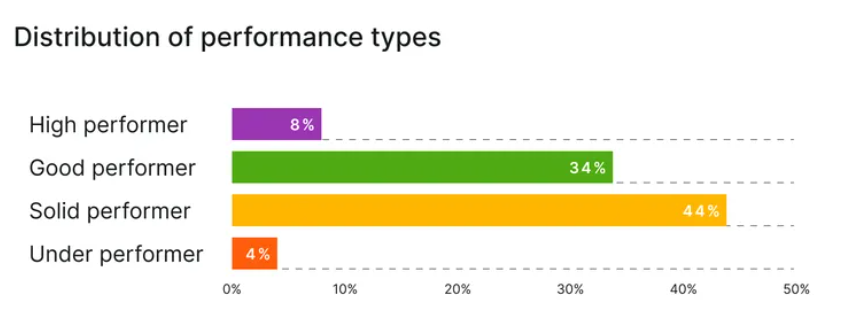
You can turn your good performers into high performers by:
- Delivering clear expectations
- Identify employees who could become HiPOs, and upskill and train them accordingly.
- Giving them support as well, employees asserted that experience with their manager was consistently at the top of the list.
Offer Consistent Feedback
Give consistent, constructive feedback to employees. Emphasize the need to support their good performers as effectively as their HiPOs. It’s equally important to prevent performance ratings from turning into a self-fulfilling prophecy. Help good performers grow into high performers by recognizing their potential, treating them accordingly, and offering equal access to learning and development opportunities.
Recognize and Reward Performance
You can recognize and reward your HiPOs by:
- Monetary and compensation-based rewards.
- Workplace privileges and special benefits.
- Family wellness packages or travel vouchers.
- Fun and workplace culture boosters.
- Publicly recognizing employees to boost their morale.
Identify High-Performing Employees With We360.ai
Track Real Work Behaviors
We360.ai provides real-time visibility into talent performance and capacity, enabling the identification of high-performing employees. The tool is equipped with data-backed insights to optimize resources and scale with confidence.
Measure Productivity with Data
Get productivity insights from data by measuring activity, tracking behavior, and mapping applications. We360.ai tracks app and website usage during working hours, categorizing them as productive, unproductive, or neutral based on role-specific relevance. This helps organizations understand where time is being invested and where it may be getting wasted.
Spot High-Performance Trends
By tracking factors like peak productive hours, app usage patterns, and task completion timelines, the platform highlights when and how employees perform at their best. For example, it can reveal whether certain teams are more productive during specific time blocks or which workflows consistently lead to faster outcomes.
Enable Data-Driven Performance Management
Through centralized dashboards, you can track key metrics such as productivity scores, active hours, task distribution, and utilization rates. This allows for objective performance reviews based on actual work patterns rather than assumptions or limited observations.
The platform also supports goal alignment by helping teams set clear KPIs and monitor progress in real time. Managers can identify performance gaps, recognize top contributors, and provide timely, data-backed feedback. This creates a fairer and more consistent evaluation process.
Conclusion
It's no longer enough to merely look at how much work someone does to find high-performing employees. You also need to know what behaviors regularly lead to great results. It starts with being able to think for yourself and work with others. It also extends to feedback; these attributes of strong performers give you a clear plan for finding and developing top employees.
When companies actively measure and cultivate these behaviors, they not only make each person work better. They also make teams work better, reduce attrition, and generate a lasting leadership pipeline. The actual benefit comes from changing from performance appraisals that happen after the fact to ongoing, behavior-driven evaluations.
By combining strategic observation with data-driven tools like We360.ai, managers can gain deeper visibility into how employees work. They can identify high-potential talent faster and create personalized growth paths. This ensures that both emerging and existing top performers are consistently supported, recognized, and retained.
Ultimately, building a high-performing workforce isn’t about chance; it’s about intentionally recognizing the right behaviors, reinforcing them, and creating an environment where talent can thrive and scale.