
Workload distribution is not as easy as we think, so there is a chance people will make mistakes.
If you look at the surface, everything will look fine and good where meetings will be held on time, deadlines chased, and employees happy, but there might be an imbalance that we cannot observe, gradually affecting the performance.
Some employees in the company are completely stretched, some are juggling multiple priorities, and some work beyond their capacity. In contrast, others have gaps in their schedules and only work on tasks that do not fully use their skills.
This is not a people problem.
It’s a work distribution problem, but how can distribution be done effectively
When work isn’t distributed effectively, it creates a ripple effect across the entire team. Productivity drops, not because people aren’t working hard, but because effort isn’t aligned with capacity or impact.
Over time, this leads to burnout, missed timelines, and disengagement that’s easy to miss until it becomes serious.
The challenge is that most teams don’t realize they’re making these mistakes until the consequences start showing.
That’s why equal distribution of workload matters more than ever. In this blog, we’ll look at where teams typically go wrong and how you can fix those gaps quickly with practical, real-world strategies.
What is Workload Distribution?
Workload distribution simply means assigning work to the team so that tasks align with each person’s capacity, skills, and priorities.
It’s not about splitting work evenly. It’s about splitting it effectively.
In many teams, work gets distributed based on availability or habit. The most reliable people get more work.
Urgent tasks go to whoever responds first. Over time, this creates an imbalance where some employees are overloaded while others are underutilized.
Effective workload distribution avoids this by taking a more structured approach.
It focuses on three things:
- Capacity: How much work someone can realistically take on without affecting quality or timelines. This includes their current workload, deadlines, and non-billable responsibilities, such as meetings or internal tasks.
- Skill alignment: Assigning tasks based on strengths and expertise. When people work within their skill set, they complete tasks faster and with better outcomes.
- Priority and impact: Not all work carries equal importance. High-impact tasks need the right attention without consistently overloading the same individuals.
When these factors are considered together, work becomes more balanced and predictable. Teams can meet deadlines without last-minute stress, and individuals have a clearer sense of ownership and accountability.
Workload distribution is about making sure the right work goes to the right people at the right time, without pushing anyone beyond their limits.
Why Workload Distribution Fails in Most Teams
Workload distribution failure is not about poor intent, but about the lack of structure in visibility. Managers might believe the distribution of work is fair, but if the system is not in the right place, it creates an imbalance within the organization.
Here are the most common reasons this happens:
Lack of Real-Time Visibility
In many teams, there’s no clear view of who is working on what at any given time.
Managers rely on status updates, scattered tools, or assumptions to understand workload. This makes it easy to overlook employees who are already stretched thin or those who have room to take on more.
Without real-time visibility, decisions are reactive instead of informed. Work gets assigned based on guesswork, not actual capacity.
Bias Toward High Performers
High performers often become the default choice for important or urgent tasks.
It feels like the safest option. They deliver consistently, so they’re trusted with more work. But over time, this creates an unhealthy pattern where a small group carries a disproportionate share of responsibilities.
Meanwhile, other team members don’t get enough opportunities to grow or contribute at a higher level. This not only leads to burnout for top performers but also limits overall team development.
No Structured Workload Tracking
When workload tracking isn’t standardized, it becomes difficult to measure or compare effort across the team.
Some tasks take hours, others take days, but without a consistent way to track them, everything looks the same on paper. As a result, workloads appear balanced when they’re not.
Teams that lack structured tracking often miss early warning signs like overbooking, uneven task distribution, or unrealistic timelines.
Ignoring Non-Billable Work
A major gap in workload distribution is the failure to account for non-billable work.
Meetings, internal communication, context switching, and administrative tasks all consume time and energy. Yet, they’re rarely considered when assigning new work.
An employee might seem available based on task load, but in reality, a large portion of their day is already occupied. Ignoring this leads to overcommitment and reduced productivity.
When these issues combine, workload distribution becomes inconsistent and unsustainable. The result isn’t just inefficiency, it’s a gradual decline in team performance and morale.
Fixing these gaps starts with recognizing them early, which is exactly what we’ll cover next.
Risks of Poor Work Distribution
When there is poor workload distribution, the impact goes beyond the performance. It affects how people work, teams collaborate, and how businesses perform over time.
Here are the key risks that show up when work isn’t distributed properly:
Productivity Decline (Busy ≠ Productive)
A team can look busy all day and still not be productive.
When work is unevenly distributed, some employees are overloaded while others have idle capacity. This imbalance slows down overall output. Tasks take longer, errors increase, and important work gets delayed.
Being busy is not the same as being effective. Without proper distribution, effort doesn’t translate into meaningful results.
Employee Burnout and Silent Attrition
Consistently overloading certain team members leads to burnout.
At first, high performers may manage the pressure. But over time, constant overload affects their energy, focus, and motivation. What makes this riskier is that burnout isn’t always visible.
Employees don’t always speak up. Instead, they gradually disengage, reduce their effort, or start looking for opportunities elsewhere. This is what leads to silent attrition, where valuable talent leaves without obvious warning signs.
Team Friction and Accountability Gaps
Uneven workload creates tension within teams.
When some people feel overworked while others appear underutilized, it leads to frustration and resentment. Collaboration starts to break down, and accountability becomes unclear.
Questions like “Who is responsible for this?” or “Why am I handling more work than others?” start to surface. Over time, this weakens trust and team cohesion.
Poor Project Delivery Timelines
When the right work isn’t assigned to the right people at the right time, timelines suffer.
Overloaded team members become bottlenecks. Tasks pile up, dependencies get delayed, and projects start missing deadlines. Even well-planned projects can fail simply because execution wasn’t balanced.
Loss of High-Value Talent
One of the most serious risks is losing your best people.
Top performers who are constantly overburdened eventually reach a breaking point. If the workload imbalance isn’t addressed, they’re more likely to leave for environments where work is managed more fairly.
Losing such employees doesn’t just create a gap. It impacts team performance, hiring costs, and overall business continuity.
Poor workload distribution doesn’t fail all at once. It creates small cracks that grow over time.
The good news is that these risks are preventable. With the right approach, you can spot imbalances early and fix them before they turn into bigger problems.
7 Proven Strategies for Effective Workload Distribution
Fixing workload distribution does not need any complex system or platform to manage. All it needs is consistency, visibility, and sound decision-making to run the team and accomplish goals.
The goal is simple: moving from reactive task assignment to a structured and balanced approach.
Let’s explore the tried-and-tested seven strategies for distributing workload effectively.
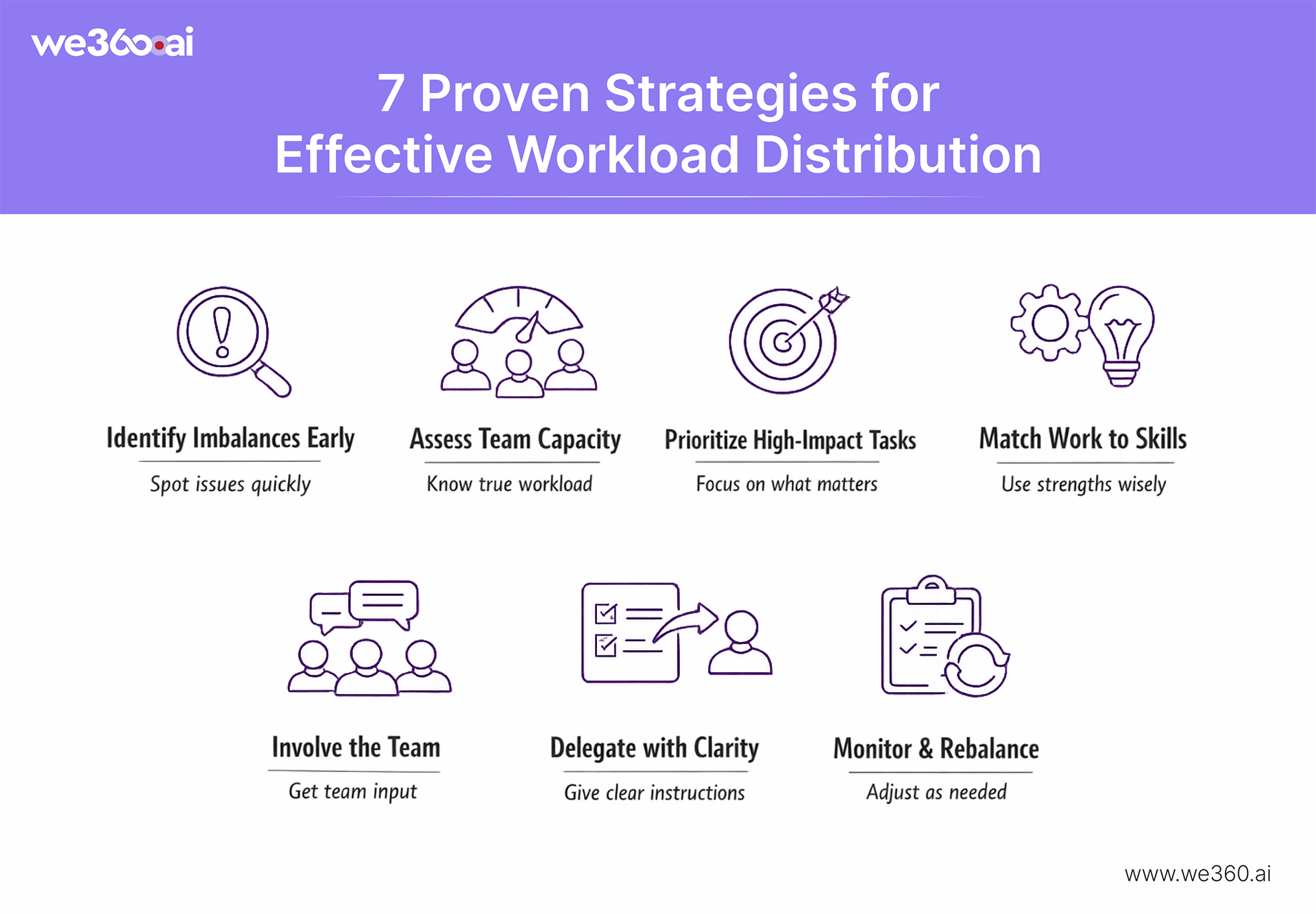
Identify Workload Imbalances Early
Most workload issues build up gradually, which makes them easy to miss.
Make it a habit to review who is working on what before problems surface. Look for signs like missed deadlines, delayed responses, or employees constantly working overtime. At the same time, check if anyone has too much idle time.
Catching these imbalances early helps you fix them before they affect performance or morale.
Assess Team Capacity (Not Just Tasks)
Counting tasks is not enough. Two people may have the same number of tasks but completely different workloads.
Focus on actual capacity. Consider deadlines, task complexity, and existing commitments. Also factor in non-billable work, such as meetings and internal coordination.
When you understand true capacity, your decisions become more realistic and sustainable.
Prioritize Work Based on Impact
Not all tasks deserve equal attention.
High-impact work should be clearly identified and prioritized. This ensures that critical tasks are completed on time without overwhelming the team with low-value activities.
Encourage teams to focus on what truly moves the needle instead of trying to do everything at once.
Match Work to Skills (Smart Allocation)
Assigning work based on skill sets improves both speed and quality.
When people work within their strengths, they require less back-and-forth, make fewer errors, and deliver better results. At the same time, you can gradually assign stretch tasks to help employees grow without overwhelming them.
Smart allocation creates a balance between efficiency and development.
Involve Your Team in Work Distribution
Work distribution should not be a one-sided decision.
When team members have visibility and a voice in how work is assigned, they are more likely to take ownership. They can also provide better input on timelines, complexity, and dependencies.
This creates transparency and reduces the chances of unrealistic expectations.
Delegate with Clarity
Poor delegation leads to confusion, rework, and delays.
When assigning tasks, be clear about expectations, deadlines, and desired outcomes. Avoid vague instructions that leave employees guessing about what needs to be done.
Clear delegation reduces back-and-forth and ensures smoother execution.
Continuously Monitor and Rebalance Workloads
Workload distribution is not a one-time activity.
Priorities change, new tasks come in, and team capacity shifts. What looked balanced at the start of the week can quickly become uneven.
Regular check-ins and adjustments help maintain balance. Even small changes, like redistributing a few tasks, can prevent larger issues down the line.
Effective workload distribution is about staying proactive. When you consistently apply these strategies, work becomes more predictable, teams stay aligned, and performance improves without unnecessary pressure.
How We360.ai Transforms Workload Distribution
Managing workload manually works only up to a point. As teams grow and work becomes more dynamic, relying on assumptions or periodic check-ins is no longer enough. This is where a data-driven approach makes a real difference.
We360.ai helps teams move from guesswork to clear, actionable insights, making workload distribution more accurate and consistent.
Move from Guesswork to Data-Driven Work Distribution
Instead of relying on visibility gaps or manual updates, We360.ai provides real-time data on how work is actually being done.
Managers can see workload patterns, time allocation, and productivity trends across the team. This makes it easier to identify who is overloaded, who has capacity, and where adjustments are needed.
Decisions are no longer based on perception. Data backs them.
Smart Work Allocation with Workforce Analytics
We360.ai goes beyond basic tracking by offering workforce analytics that highlight how time and effort are distributed.
It helps managers assign tasks more intelligently by understanding employee capacity, work patterns, and performance trends. This ensures that work is allocated not just evenly, but effectively.
The result is a better balance without constant manual intervention.
Prevent Burnout Before It Happens
One of the biggest advantages of using data is early detection.
We360.ai helps identify signs of overwork, such as consistently long hours, high activity without meaningful output, or uneven task distribution. This allows managers to step in before burnout becomes a serious issue.
Instead of reacting late, teams can take preventive action.
Improve Team Productivity Without Micromanagement
Tracking work often raises concerns about micromanagement. But when used correctly, it does the opposite.
We360.ai focuses on outcomes and patterns, not constant supervision. It gives managers the visibility they need while allowing employees to work independently.
This creates a balanced environment where productivity tracking improves without adding unnecessary pressure.
With the right insights in place, workload distribution becomes less about constant oversight and more about making informed, timely decisions. That’s what enables teams to stay productive, balanced, and sustainable in the long run.
Best Practices for Managing Workload Effectively
Even with the right strategies and tools in place, workload distribution needs consistent habits to stay effective. These best practices help ensure that work remains balanced as teams grow and priorities shift.
Standardize Workload Tracking
Without a consistent system, it’s difficult to measure or compare workloads across the team.
Define how work will be tracked. This could include task duration, complexity levels, or categories of work. When everyone follows the same structure, it becomes easier to spot imbalances and make fair decisions.
Use Data Dashboards
Visibility is key to maintaining balance.
Dashboards give a clear view of who is working on what, how time is being spent, and where bottlenecks are forming. Instead of digging through multiple tools or updates, managers can quickly assess workload at a glance.
This makes decision-making faster and more accurate.
Avoid Over-Reliance on Top Performers
It’s tempting to assign critical tasks to your most reliable employees. But doing this repeatedly creates long-term problems.
Distribute high-impact work more evenly and allow others to step up. This not only reduces pressure on top performers but also strengthens the overall team.
Set Realistic Deadlines
Unrealistic timelines are one of the fastest ways to overload a team.
Before committing to deadlines, consider actual capacity, existing workload, and task complexity. Giving teams enough time to deliver quality work reduces stress and improves outcomes.
Conduct Weekly Workload Reviews
Workloads change quickly, which is why regular reviews are important.
A simple weekly check-in helps identify overload, underutilization, or shifting priorities. It also creates space for team members to raise concerns early.
These small, consistent reviews prevent larger issues from building up.
Conclusion
Workload distribution is not just an operational task. It directly impacts productivity, employee well-being, and long-term team performance.
When work is distributed without structure or visibility, even strong teams begin to struggle. Imbalances grow, burnout increases, and results start to slip.
The good news is that these problems are fixable.
By focusing on capacity, aligning work with skills, and using data to guide decisions, teams can create a more balanced and efficient way of working. It doesn’t require a complete overhaul, just a more intentional approach.
When workload distribution is done right, teams don’t just get more done. They work better, with less stress and more clarity.