

Growing a business from a nimble startup to a thriving enterprise is a monumental achievement. It’s a journey filled with strategic decisions, talent acquisition, and the constant pursuit of efficiency. However, as organizations expand, the very systems and processes that once served a small team can quickly become bottlenecks, creating headaches rather than facilitating progress. The challenge isn't just about managing more people; it's about maintaining clarity, control, and productivity across an increasingly complex operational landscape.
This blog post will explore the common pitfalls companies encounter when scaling their workforce management and how a robust, adaptable workforce intelligence platform can transform this journey. We'll delve into how to transition from informal oversight to data-driven insights, ensuring your growth is not just rapid, but also sustainable and headache-free. You'll learn how to maintain agility, optimize resources, and empower your teams, no matter your size.
The Growing Pains: Why Scaling Workforce Management Gets Complicated
What works for a team of 10 often crumbles under the weight of 100 or 1000. The transition from small team to enterprise brings unique challenges to workforce management that, if not addressed proactively, can stifle growth and create significant operational friction.
1. Losing the Personal Touch: The Erosion of Intuitive Oversight
In a small team, a leader often has an almost intuitive understanding of each team member's workload, strengths, and challenges. They can spot burnout, identify inefficiencies, and reallocate tasks with a quick conversation. As the organization scales, this personal oversight becomes impossible. Managers are further removed from day-to-day activities, and the informal communication channels that once kept everyone aligned begin to fray. This leads to a lack of visibility, where leaders are making decisions based on assumptions rather than objective reality.
2. Data Silos and Fragmented Insights: A Jigsaw Puzzle of Productivity
Enterprises typically adopt a variety of specialized tools for HR, project management, CRM, and communication. While each tool serves a purpose, they often operate in isolation, creating islands of data. This fragmentation makes it incredibly difficult to get a holistic view of workforce performance. HR might have data on attendance, project managers on task completion, and finance on payroll, but connecting these dots to understand true productivity, resource allocation, or the impact of initiatives becomes a complex, manual, and often inaccurate process. This lack of integrated insight prevents strategic decision-making.
3. Inconsistent Processes and Compliance Risks: The Cost of Chaos
What starts as flexible, ad-hoc processes in a small team can become a significant liability at scale. Inconsistent time tracking, varied project methodologies, and differing approaches to performance management across departments or regions can lead to operational chaos. This not only impacts efficiency but also introduces compliance risks, especially concerning labor laws, overtime regulations, and data privacy. Without standardized, transparent systems, ensuring fairness, accuracy, and adherence to regulations becomes a constant battle.
The Enterprise Advantage: Building a Scalable Workforce Intelligence Framework
Scaling effectively means building a robust framework that provides clarity and control without stifling innovation or flexibility. A modern workforce intelligence platform is designed to offer this, transforming potential headaches into strategic advantages.
1. Unified Visibility: Your Single Source of Truth
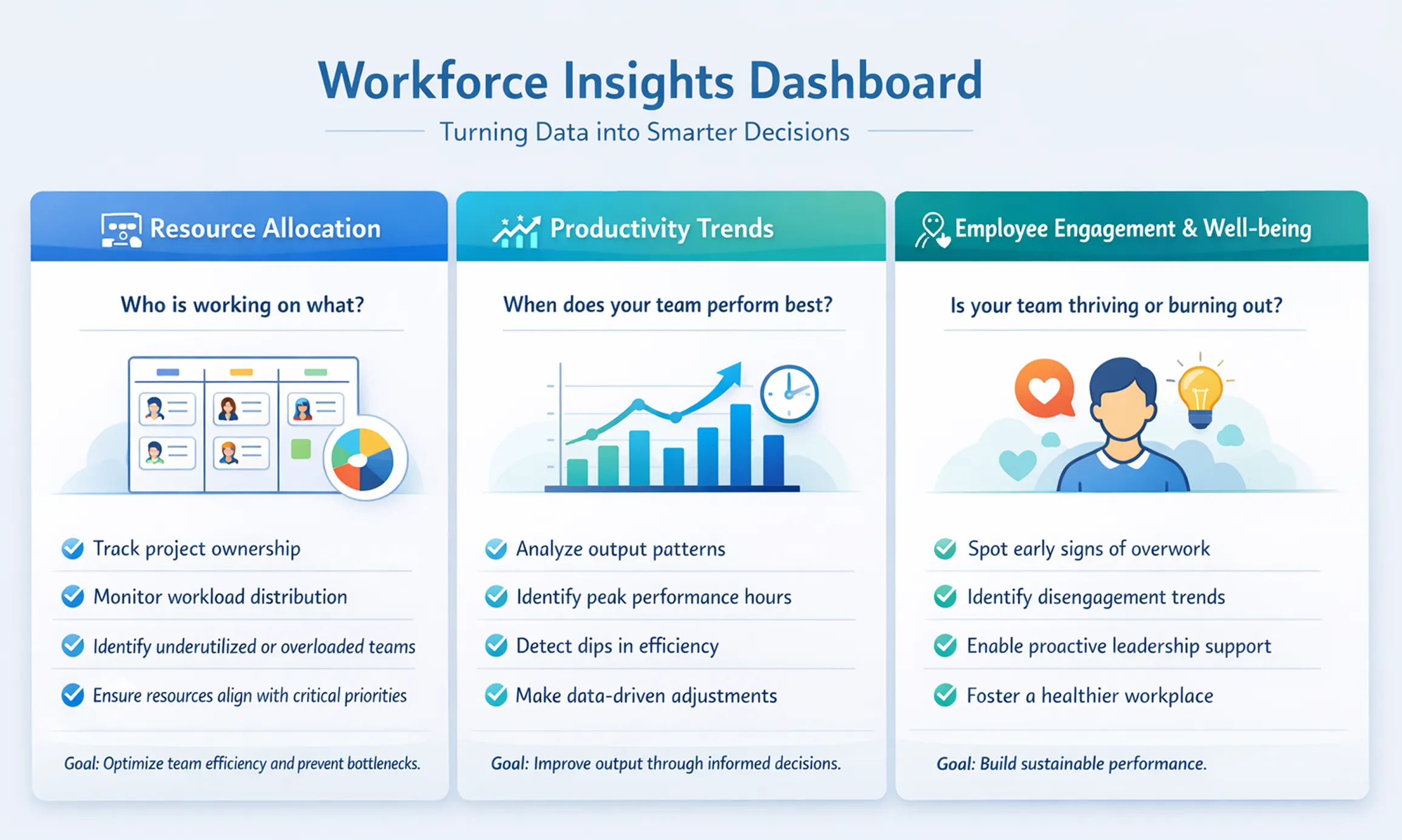
For an enterprise, a single, comprehensive view of workforce activity is invaluable. This means integrating data from all your existing systems—HRIS, project management tools, communication platforms—with real-time activity intelligence. The goal is to create a dashboard that provides leaders with immediate, actionable insights into:
- Resource Allocation: Who is working on what, and are resources optimally distributed across critical projects and teams?
- Productivity Trends: Identify patterns in team output, understand peak performance times, and pinpoint areas where efficiency might be dipping.
- Employee Engagement & Well-being: Spot early indicators of overwork or disengagement, allowing for proactive intervention and support.
This unified visibility eliminates guesswork, enabling leaders to make informed decisions about staffing, project prioritization, and operational adjustments across the entire organization.
2. Adaptable Automation: Streamlining Without Rigidity
Scaling doesn't mean sacrificing flexibility for rigid processes. Instead, it means leveraging intelligent automation to streamline routine tasks and enforce consistent policies, while still allowing for necessary adaptation. A scalable workforce intelligence solution can:
- Automate Time Tracking & Reporting: Move beyond manual entries to accurate, system-driven time tracking that integrates seamlessly with payroll and project billing, reducing administrative burden and errors.
- Implement Custom Rules: Establish smart rules to identify specific scenarios, such as potential overtime exposure, underutilized licenses, or teams consistently exceeding project timelines. These rules can be tailored to different departments, regions, or employee types.
- Flag Anomalies Proactively: Instead of reacting to problems, the system can proactively alert managers to potential issues like unusual activity patterns or significant deviations from project plans, allowing for timely intervention.
This blend of automation and adaptability ensures that as your enterprise grows, your operational processes become more efficient and compliant, not less.
3. Data-Driven Empowerment: Fostering a Culture of Trust
At enterprise scale, fostering a culture of trust and empowerment is paramount. Workforce intelligence, when implemented thoughtfully, supports this by providing objective data that facilitates fair performance discussions, identifies training needs, and recognizes contributions. It shifts the focus from subjective assessments to measurable impact, enabling:
- Fair Performance Management: Objective data provides a neutral basis for performance reviews, helping to identify top performers and areas for development without bias.
- Targeted Training & Development: By understanding skill utilization and gaps across the organization, leaders can invest in training programs that truly meet the needs of their evolving workforce.
- Employee Well-being Initiatives: Data can highlight workload imbalances or periods of high stress, allowing HR and management to implement well-being programs that genuinely support employees at scale.
When employees understand that data is used to support their growth and optimize their work environment, it builds a foundation of trust essential for a thriving enterprise.
Conclusion: Your Growth, Simplified
The journey from a small team to an enterprise is complex, but managing your workforce doesn't have to be a source of constant headaches. By adopting a scalable workforce intelligence platform, you can gain the clarity, control, and adaptability needed to navigate rapid growth with confidence. It's about building a future where every expansion brings new opportunities, not new operational burdens, and where your people remain your greatest asset, empowered by insights and supported by intelligent systems.
.png)