
AI employee monitoring software has moved from a nice-to-have feature to a core operations layer in 2026, especially for distributed Indian and APAC teams. The shift is driven by hybrid work, generative AI usage at the desk, and rising compliance pressure. This guide explains how the technology works, what the law allows, and which five tools deserve a shortlist this year.
Understanding the Landscape
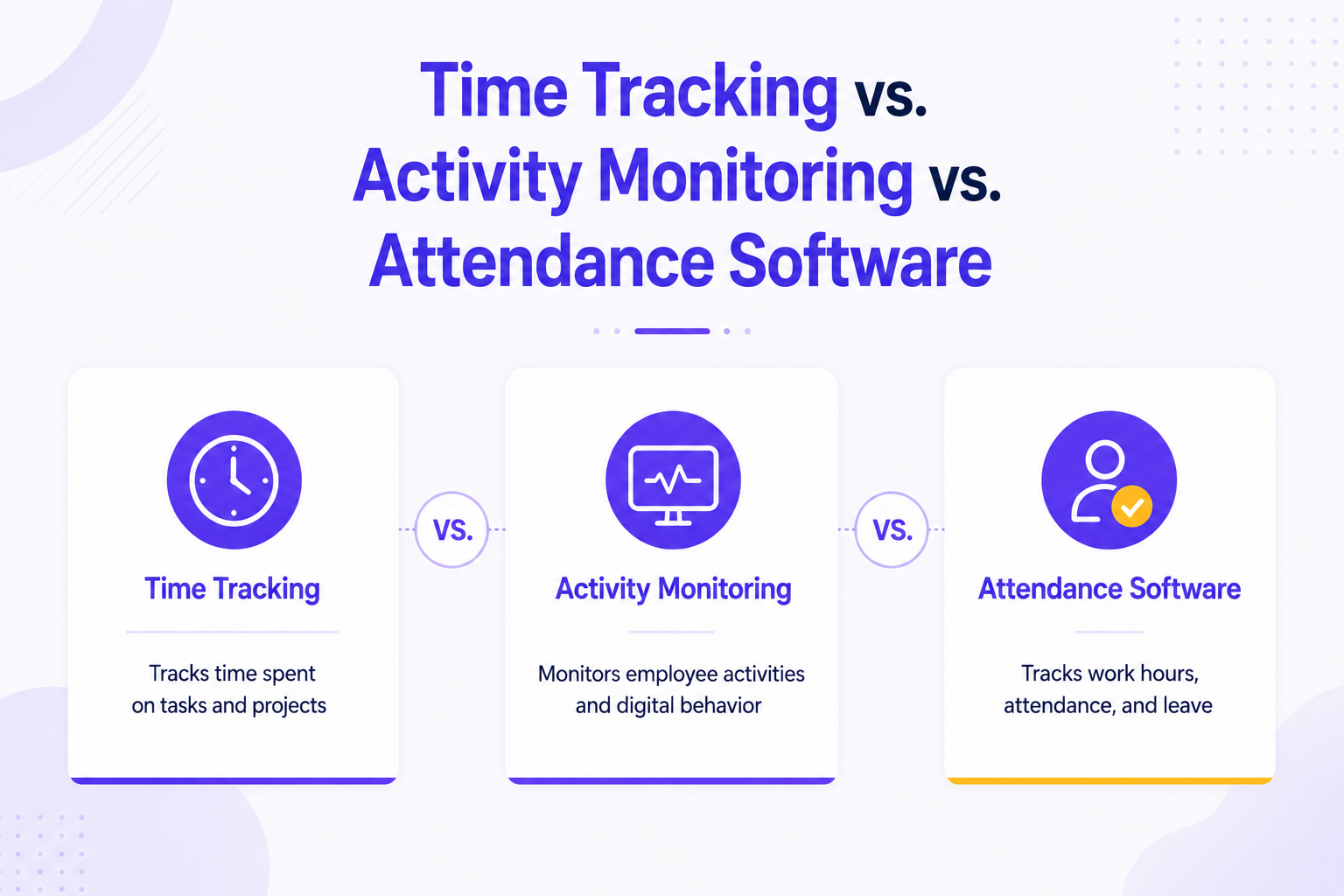
AI employee monitoring software is workforce analytics technology that captures workplace signals such as applications used, websites visited, active versus idle time, keystroke cadence, and meeting load. It then applies machine learning models to classify productivity, detect anomalies, and forecast risk. Unlike legacy spyware, modern AI monitoring tools focus on aggregated patterns rather than keystroke-by-keystroke surveillance.
According to Gartner’s Employee Productivity Monitoring Software reviews, buyer demand has shifted toward platforms that combine activity data with well-being and engagement signals. Reddit threads in r/sysadmin echo the same sentiment. IT leaders want analytics, not bossware.
[Image: dashboard heatmap showing aggregated team productivity by hour, placement: inline · alt=‘AI employee monitoring software dashboard with productivity heatmap’]
Why this matters for modern distributed teams
Hybrid teams produce fragmented signals. A developer in Bengaluru, a designer in Manila, and an account manager in Dubai all generate different activity footprints. AI workforce monitoring normalises this data so managers can compare output by outcome rather than seat time. It also flags burnout, including long after-hours streaks, weekend logins, and meeting overload, before attrition spikes.
For Indian SMBs running 50 to 500 employees, this matters because manual review simply does not scale. AI monitoring tools collapse what used to take a team lead three hours a week into a five-minute dashboard glance.
Key features to look for
A 2026-grade platform should offer automated activity classification, idle-time detection, configurable and consent-based screenshot capture, application and URL analytics, project-level time tracking, attendance and shift management, and an AI-usage audit module. Look for role-based access control, anonymised manager views, and exportable audit logs for compliance teams.
Integrations matter as much as features. Native connectors to Slack, Microsoft Teams, Jira, Zoho People, and Keka reduce the yet-another-dashboard tax. Mobile and field-force support is now table stakes for BPO and logistics teams.
Legal & Compliance Checklist
AI employee monitoring is legal across most jurisdictions when three conditions are met. There must be a documented business purpose, informed employee consent, and proportionate data collection. In India, the Digital Personal Data Protection Act, 2023, and the IT Act, 2000, set the baseline. The EU’s GDPR and California’s CCPA add stricter notice and minimisation duties for global teams.
A practical compliance checklist for 2026 includes:
- Publish a written monitoring policy in the employee handbook and offer letter.
- Capture explicit, signed consent. Digital signatures are valid under the IT Act.
- Limit data collection to working hours and company-issued devices.
- Encrypt data in transit (TLS 1.3) and at rest (AES-256).
- Define a retention period of 90 to 180 days and auto-purge after.
- Give employees access to their own dashboards, also known as the right to explanation.
- Run a quarterly Data Protection Impact Assessment (DPIA).
Compliance and ethics considerations
The legal floor is not the ethical ceiling. Even where keystroke logging is permitted, ask whether it serves a measurable business outcome. Most teams get 90% of the value from application and idle-time analytics alone, with screenshots reserved for high-risk roles such as finance and legal.
Employee Privacy & Trust
Trust collapses when monitoring is invisible. It strengthens when monitoring is transparent, two-way, and tied to coaching. The most successful rollouts We360.ai has supported across 21+ countries share three traits. Employees see their own data, managers see aggregated team data, and only compliance officers can view individual records, and only with a logged reason.
[Image: split-screen showing employee self-view dashboard vs. manager aggregated view, placement: inline · alt=‘AI employee monitoring software privacy-first dual dashboard view’]
Consider the private-mode toggle. Employees should be able to mark personal time such as a doctor’s appointment or a banking task as private, with the tool recording only the duration and not the content. Reddit discussions on r/sysadmin repeatedly cite this single feature as the difference between adoption and revolt.
The cultural framing matters too. Position the rollout as a productivity-coaching system rather than a punishment tool. Share team-level dashboards in retros. Celebrate teams that reduce after-hours work, not those with the highest active hours.
ROI & Business Impact
Across We360.ai’s 10K+ customer base, the median productive-hour gain in the first quarter is 11% to 18%, with BPO and IT services teams seeing the upper end. Three ROI levers compound over time. These are recovered idle time, reduced shadow IT licensing waste, and lower attrition from earlier burnout detection.
Measuring ROI and proving impact
Build a baseline before switch-on. Capture average daily active hours, weekly meeting load, after-hours percentage, and a self-reported engagement score. Re-measure at days 30, 60, and 90. A simple ROI formula is:
ROI % = ((Recovered hours × loaded cost per hour) − tool cost) ÷ tool cost × 100
For a 200-person Indian IT services firm at ₹600 per hour loaded cost, recovering just 30 minutes per employee per day yields about ₹3.6 crore in annualised capacity against a tool spend of roughly ₹7.2 lakh, an ROI north of 4,900%.
Industry-specific considerations (BPO, IT services, banking)
BPO operations care most about average handle time, schedule adherence, and screen recording for QA. IT services teams optimise for billable utilisation and project burn rate. Banking and BFSI prioritise insider-threat detection, DLP integration, and immutable audit trails for RBI and SEBI inspections. The right AI employee monitoring software lets each function configure its own KPI stack on shared infrastructure.
Choosing the Right Tool – Decision Framework
Shortlist on five axes. These are data depth, privacy controls, AI insight quality, integration breadth, and total cost of ownership. Then run a two-week paid pilot with 25 to 50 users before signing an annual contract.
Below are five platforms worth evaluating in 2026.
1. We360.ai. Built for India and APAC with rupee-first pricing from ₹299 per user per month, We360.ai pairs activity analytics with an Agentic AI layer that auto-generates manager nudges and weekly team summaries. It is strong on attendance, configurable screenshots, productivity scoring, and a privacy-first private-mode toggle. It is trusted by 120K+ users across 21+ countries. Explore the Agentic AI feature set and the broader employee monitoring solution.
2. Teramind. Enterprise-grade behaviour analytics with deep DLP and insider-threat detection. Pricing starts around USD 15 per user per month. It is best for regulated industries but can feel heavy for SMBs.
3. ActivTrak. Strong productivity analytics and benchmarks against anonymised peer data. It has limited screenshot and field-force features. Pricing is in the USD 10 to 17 per user per month band.
4. Hubstaff. Time tracking, GPS, and payroll-friendly workflows. It is popular with agencies and remote-first teams. It is lighter on AI insights than the leaders.
5. Insightful (formerly Workpuls). Clean UI, solid productivity scoring, and good Mac support. It has a smaller integration catalogue than We360.ai or Teramind.
People also evaluate WebWork, and the WebWork Tracker AI module is worth a look for screenshot-heavy workflows. For broader reviews, see PeopleManagingPeople’s roundup and Maxel’s top AI tools list.
Pricing models, per-user, per-seat, and enterprise
Three models dominate in 2026. Per-user monthly billing of ₹299 to ₹1,500 suits growing teams. Per-seat annual billing offers 15% to 25% discounts and works for stable headcounts. Enterprise contracts add SSO, on-prem or private-cloud deployment, custom DPAs, and dedicated CSMs, usually starting at 250 seats.
Watch for hidden costs. Screenshot storage, API call limits, mobile-app add-ons, and historical data retention beyond 90 days are the four most common surprise line items.
Want to see how this works for your team? Book a Demo → /demo
Implementation Roadmap
A phased rollout beats a big-bang launch every time. Below is the playbook that We360.ai customer success teams use across BPO, SaaS, and BFSI deployments.
Implementation roadmap (week 1, month 1, quarter 1)
Week 1, Foundation. Form a steering committee with HR, IT, Legal, and one line manager. Draft the monitoring policy, update offer letters, and pick a pilot team of 25 to 50 users. Configure the tool with role-based access and a 90-day retention window.
Month 1, Pilot. Run the pilot with full transparency. Hold a kickoff session explaining what is and is not captured. Share self-view dashboards with each pilot employee from day one. Collect feedback weekly and tune classification rules.
Quarter 1, Scale. Roll out department by department rather than all at once. Train managers on how to read dashboards as coaching tools and not performance-review weapons. Re-measure baseline KPIs at days 30, 60, and 90. Publish a quarterly transparency report internally.
Common pitfalls to avoid
Four failure modes show up most often. These are rolling out without written consent, using monitoring data in performance reviews without prior disclosure, over-collecting (screenshots everywhere, all the time), and ignoring manager training so dashboards go unused. Each one is avoidable with a 30-minute checklist conversation up front.
Monitoring AI Usage by Employees
The newest dimension in 2026 is governing how employees use generative AI. Shadow AI, where staff paste customer data into public ChatGPT, Claude, or Gemini sessions, is the fastest-growing data-leak vector flagged by Indian CISOs.
Modern AI employee monitoring software now includes an AI-usage audit module. It logs which AI tools are accessed, flags sensitive-data prompts via on-device classifiers, and produces a weekly AI footprint report. This is distinct from blocking AI because the goal is visibility plus guardrails so teams can adopt AI safely.
[Image: AI usage audit panel showing top generative-AI tools and risk-flagged prompts, placement: inline · alt=‘AI workforce monitoring panel auditing generative AI usage by employees’]
Pair the audit module with an internal AI-acceptable-use policy and a sanctioned enterprise AI tool. Employees rarely route around governance when a fast, approved option exists.
Ethical Best Practices
Five principles separate ethical AI monitoring from surveillance theatre. Transparency means publishing exactly what is collected, how long it is kept, and who can see it. Proportionality means collecting the minimum data needed for the stated purpose. Reciprocity means giving employees their own dashboards and the right to dispute classifications. Purpose limitation means never repurposing monitoring data for unrelated decisions like layoffs without separate notice. Human oversight means any adverse action triggered by AI signals must be reviewed by a human manager.
The WorkTime guide on AI employee productivity monitoring makes a useful point. Ethical monitoring is a competitive advantage in tight talent markets like Bengaluru, Hyderabad, and Singapore.
Future Trends (2026 to 2028)
Four trends will shape the next 24 months. First, agentic AI assistants will move from passive dashboards to active coaches that nudge employees and managers in real time. Second, on-device inference will replace cloud uploads for sensitive signal types and ease DPDP and GDPR compliance.
Third, well-being analytics such as sleep-adjacent burnout indicators and meeting-fatigue scores will become a standard tab alongside productivity. Fourth, regulators in India, the EU, and Australia are expected to publish AI-monitoring-specific guidance by 2027 and formalise consent and explainability requirements that leading vendors already meet.
The best AI employee monitoring software of 2028 will look less like a tracker and more like a workforce-intelligence operating system. It will respect privacy by default and prove ROI in board-ready dashboards.
Frequently Asked Questions
Final CTA
You do not need a 12-month rollout to see results. You need a transparent policy, the right tool, and a 30-day pilot. We360.ai gives operations and HR leaders productivity, attendance, and AI usage insight on one privacy-first platform, starting at ₹299 per user per month. 120K+ users, 10K+ companies, and 21+ countries trust We360.ai.
Start Free Trial – No Credit Card · Book a Demo