




Summarize With AI


Key Take Aways
- Start with a skill that solves a real problem — writing, marketing, design, technology, automation, or consulting can become profitable services.
- Choose a specific niche instead of offering generic services. Specialization helps you stand out and charge more.
- Use AI and automation as leverage to handle repetitive work, improve efficiency, and scale without a large team.
- Start lean and focus on revenue first — you don’t need a perfect website, logo, or expensive tools to get your first customers.
- Focus on client acquisition and distribution through outreach, LinkedIn, content, SEO, or other channels rather than waiting for customers to find you.
- Systemize once you gain traction — use processes, templates, automation, and productivity tools to manage more work without creating chaos.
Most people don’t fail at online business because it’s hard.
They fail because they start the wrong thing.
In 2026, the game has changed. You no longer need a big team, a fancy office, or years of capital to build something profitable. What you do need is a skill that solves a real problem, a simple system to deliver it, and the ability to use AI as leverage, not a crutch.
Here’s the hard truth: the internet is crowded, but it’s not saturated with people who know what they’re doing. While many are still chasing trends, the ones quietly making money are building lean, skill-based businesses that run from a laptop and scale globally.
This shift is bigger than just “working from home.” It’s about owning your income instead of renting it from a job. It’s about building something that grows because of your skills, not your hours.
If you’ve been thinking about starting a remote business, this is the right time. Not because it’s easy, but because the tools, access, and demand have never been more in your favor.
Let’s break down what actually works now.
Why Starting a Business from Home in 2026 Is a Strategic Advantage
Starting a business from home isn’t a compromise anymore. It’s a smarter way to build.
A few years ago, working from home was considered a temporary solution, but today it has become a convenient option and part of every organization. It provides speed, flexibility, and control that traditional business standards cannot match.
Let’s understand how!
- Zero infrastructure = higher profit margins: When you remove rent, utilities, and operational overhead, your break-even point drops instantly. That means you can stay profitable with fewer clients and reinvest faster. You’re not feeding a system, you’re building one.
- AI + automation = solo founders scaling like teams: What used to require 5 people can now be handled by 1 person with the right tools. From content creation to customer support to lead generation, AI helps you move faster without burning out. You’re not just working alone, you’re operating with leverage.
- Global demand for niche services: You’re no longer limited by geography. A designer in India can work with a startup in Canada. A consultant can serve clients across time zones. And the more specialized your skill, the easier it is to stand out and charge premium rates.
- Shift from job security → skill ownership: Jobs feel stable until they aren’t. Skills, on the other hand, travel with you. When you build a business around what you can do, you’re not dependent on a single employer. You’re building an asset that grows with you.
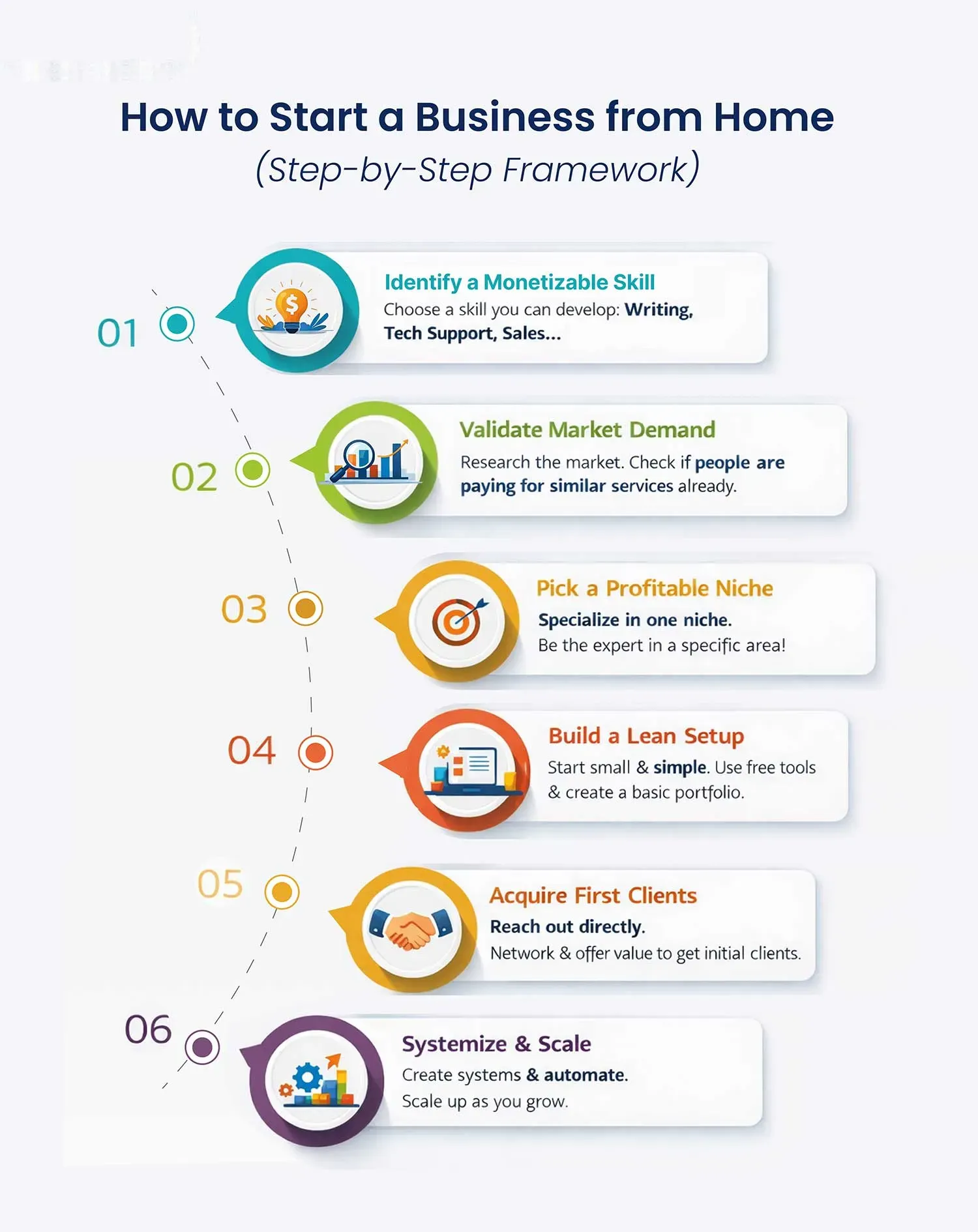
How to Start a Business from Home (Step-by-Step Framework)
Managing and running businesses online or from home is not about having the perfect idea; it’s all about having clarity for the process and discipline. Let’s understand how you can set up your online business work-from-home framework. What is mandatory and what is not!
Step 1: Identify a Monetizable Skill
Here, skill is an important starting point. Know what you can do, what you can develop, learn, grow, and grasp. Writing, design, marketing, tech support, sales, and automation are simple business skills that can be learned and developed.
The key here is simple. If these skills solve your customer's problem, they will pay you, and you are in business.
Step 2: Validate Market Demand
Research, research, and more research. Check whether people are already paying for or aware of similar services you provide? Explore freelance platforms like LinkedIn and job boards to see what others are doing and how they run similar businesses.
Check out the demand graph and study it. Your goal here is not to invent demand but simply tap into it and find the USP.
Step 3: Pick a Profitable Niche
If you are dapper with the basic skills, you will struggle a lot in the competitive market. But if your skills are polished, well-researched, and out of the box, you will rock the market. For this, you do not need to be a “jack of all trades”; simply get specialization in one niche.
Simply writing “social media management” on a LinkedIn profile won’t grow trust; instead, write “Instagram growth for fitness coaches” or “LinkedIn content for SaaS Founders”. Having a specialization in a clear niche will make you easier to trust, and you will be chosen for hire.
Step 4: Build a Lean Setup
Don’t rush things to make everything from day one. Instead, start by using free platforms to cover the basics, create a simple portfolio (even 2-3 samples would work to showcase), and get a master at communicating things.
The first goal should be generating revenue, not perfection.
Step 5: Acquire First Clients
Don’t hesitate to reach out to people, but don't sound desperate just by reading posts. This is where most people hesitate. Don’t. Reach out directly. Send messages, post content, and offer value upfront. Your first few clients won’t come from ads. They’ll come from conversations and consistent outreach.
Step 6: Systemize & Scale
Once you have consistent work, the system starts to build. Templates, processes, automation, and their scaling can all be done gradually.
There’s no magic here. Just a clear path. Follow it, stay consistent, and results compound faster than you expect.
15 Best Online Business Ideas from Home (2026 Edition)
In 2026, businesses’ goals are clear. Solve problems and scales without burning.
We have gathered 15 business ideas that you can ace in 2026, and that too online.
Absolutely, this is where the content can really stand out. Let’s make it more engaging, story-driven, and memorable while still being practical.
- SEO Content & Copywriting Business : Each business wants to stay available online and rank in the top 10. It can be generated through blending the right strategies of content writing, copywriting, and SEO. Skilled writers win here as they help companies and brands to grow and bring sales.
If you can do both, you are not just a common writer, but a revenue driver of multiple companies. Considering HubSpot, it drives millions of visitors through SEO-driven content, and behind the attraction of traffic lies the right implementation of strategies. - Social Media Management (Niche-Based) : Social media is crowded; to stand out from competitors, you first need to master the niche you select and better understand your audience.
Generic content gets ignored. Niche content builds audiences.
Look at Gymshark. Their social presence isn’t random; it’s deeply tied to fitness culture. If you manage content specifically for, say, fitness coaches or real estate agents, you become far more valuable. - AI Automation Services : Businesses are overwhelmed with repetitive tasks. Automation is no longer optional.
Companies like Zapier built an entire ecosystem around this need. If you can help businesses automate workflows, you’re saving them time and money every single day. - Digital Marketing Agency : Growth is always in demand. The difference now is specialization.
Neil Patel Digital didn’t grow by doing everything randomly. It focused on results and built authority. Start small, prove ROI, then scale. - Affiliate Marketing (Authority-Based) : People don’t buy links. They buy trust.
Websites like Wirecutter make millions by recommending products with honest, in-depth reviews. If you build authority, the income follows. - Online Coaching / Consulting : Your experience can be someone else’s shortcut.
Marie Forleo built a global brand by packaging business advice into coaching and programs. If you’ve solved a problem before, you can teach it. - E-commerce (Low Inventory Models) : You don’t need a warehouse to build a brand anymore.
Printful powers thousands of online stores without inventory headaches. The barrier to entry is lower than ever, but branding is what makes you stand out. - Freelance Graphic Design : Design isn’t decoration. It’s perception.
Canva proved how valuable a simple, effective design can be. Businesses constantly need visuals that communicate clearly and quickly. - Virtual Assistant Services (Specialized) : General help is cheap. Specialized help is premium.
Many founders hire VAs for tasks like email funnels or CRM management. Platforms like Belay built entire businesses around this demand. - Course Creation : Teach once, sell repeatedly.
MasterClass turned knowledge into a scalable product. You don’t need celebrity status. You just need clarity and results. - YouTube / Content Creation Business : Attention is the new currency.
Creators like MrBeast built massive businesses from content alone. It starts slow, but once it clicks, the leverage is unmatched. - Remote Tech Support / IT Services : Tech breaks. Businesses panic. You solve.
Companies like Geek Squad exist because people will always need help with technology. Remote support makes it even easier to deliver. - Resume & LinkedIn Optimization Services : First impressions are now digital.
TopResume built a strong business helping professionals stand out. With remote hiring growing, this demand keeps increasing. - Website Flipping : Buy, improve, sell. Simple in concept, powerful in execution.
Platforms like Flippa make it possible to trade websites like digital real estate. If you understand traffic and monetization, this can be very profitable. - Newsletter Business : Small audience, big influence.
Morning Brew started as a simple email and turned into a multi-million dollar media brand. A focused newsletter can become a serious asset.
Related read: Remote Work vs Office Productivity: Are Remote Workers More Productive?
Most Profitable Small Business Ideas From Home (By Category)
Not every business is built for the same goal. Some are designed to bring in quick cash with minimal investment. Others take more effort but can scale into high-income assets. And a few, if done right, can generate income even when you’re not actively working.
Instead of looking at ideas randomly, it helps to understand them by category. That’s how you pick something that actually fits your goals.
Low Investment Home Small Business Ideas (Start Fast, Risk Less)
We have listed a few of the easiest businesses to start because they rely more on your skills than your money, and are something to start and get on with.
Freelancing
This is the fastest way to make money from home. You offer a service, find a client, and get paid. Writing, design, video editing, marketing, and tech support. The barrier to entry is low, but competition exists, so positioning matters. The more specific your skill, the faster you stand out.
Affiliate Marketing
You don’t need your own product. You promote someone else’s product and earn a commission. The real work here is building trust through content, whether it’s a blog, YouTube channel, or social media page. It starts slow, but once content ranks or gains traction, it compounds.
Content Creation
This includes YouTube, Instagram, blogging, or even niche communities. You’re building attention first, then monetizing through ads, sponsorships, or products. It requires consistency more than money, which is why many quit early. Those who stay win big over time.
High Income Potential (Scale Bigger, Earn More)
The models mentioned below require more effort and skill, but the upside is significantly higher.
Consulting
If you know how to solve a specific problem, businesses will pay for your advice. This could be a marketing strategy, career coaching, operations, or finance. You’re not selling time, you’re selling expertise. The more results you can prove, the higher you can charge.
Agencies
An agency is simply a scaled version of freelancing. Instead of doing everything yourself, you build a small team and handle multiple clients. Services like digital marketing, design, or lead generation work well here. This model can grow fast, but only if you build strong systems.
AI Services
This is one of the fastest-growing opportunities right now. Businesses want to use AI but lack the knowledge to implement it properly. Setting up automations, AI workflows, or integrations can command premium pricing because they directly save time and reduce costs.
Passive Income Home Small Business Ideas (Build Once, Earn Repeatedly)
Let’s be clear. “Passive” doesn’t mean no work. It means doing the work up front and getting paid overtime.
Online Courses
You package your knowledge into a structured format and sell it. The effort is front-loaded, creating content, organizing lessons, and marketing. Once done, it can generate income repeatedly with minimal updates.
Affiliate Sites
Unlike casual affiliate marketing, this involves building a full website around a niche. You create SEO-driven content, rank on search engines, and earn commissions consistently. It takes time to build, but it can become a reliable income stream.
Digital Products
Templates, eBooks, tools, or resources. These are low-cost to create and easy to distribute. The key is solving a specific problem. A well-made product can sell for months or even years without major changes.
Common Mistakes When Starting an Online Business from Home
Most people dial because they make predictable mistakes in the early stages, but if avoided, you are already ahead of most beginners.
We have pointed out a few common mistakes that help you to avoid confusion and move
- Choosing saturated niches without differentiation : Saying “this niche is too crowded” is usually an excuse. The real problem is a lack of positioning. If you’re just another “freelance writer” or “social media manager,” you’ll struggle.
But if you’re a LinkedIn content writer for B2B founders or an Instagram manager for fitness coaches, you stand out instantly. Saturation only hurts when you look the same as everyone else. - Focusing on the logo instead of the revenue : Many beginners spend weeks picking colors, designing logos, and building websites. None of that brings money in the beginning.
Your first goal is simple: get a paying client. A basic offer and clear communication will outperform a perfect brand with zero customers. - Ignoring distribution (no traffic strategy) : You can have the best service or product, but if no one sees it, it doesn’t matter. Whether it’s LinkedIn, YouTube, cold outreach, or SEO, you need a way to get in front of people consistently. Distribution isn’t optional; it’s the backbone of your business.
- Underpricing services : Charging too low might get you quick clients, but it also attracts the wrong ones and leads to burnout—price based on value, not fear. If your work helps a business make or save money, you deserve to be paid accordingly.
- Trying multiple ideas instead of committing to one : Jumping from one idea to another feels productive, but it resets your progress every time. Most successful businesses look simple from the outside because the founder stuck with one thing long enough to make it work.
Tools You Actually Need to Run a Remote Business
You don’t need dozens of tools to get started. In fact, too many tools can slow you down. A small, reliable stack is enough to run and scale efficiently.
Productivity & Monitoring
Tools like We360.ai help you understand how you spend your time, especially as you grow or start working with a team. It gives clarity on productivity, which is critical when everything runs remotely.
Related read: Master Remote Working: 10 Productivity Hacks That Work
Communication
Clear communication keeps everything moving. Platforms like Slack for messaging and Zoom for meetings make collaboration simple, whether you’re working with clients or a team.
Finance & Accounting
Money management can’t be an afterthought. Tools like QuickBooks help you track income, expenses, and overall financial health without confusion.
How to Scale Your Work-from-Home Business Faster With Employee Productivity
Scaling a remote business sounds exciting until things start slipping.
Deadlines get missed. Productivity becomes inconsistent. You’re working more, but output doesn’t match the effort. This is the point where most founders realize growth without visibility creates chaos.
That’s where tools like We360.ai come in.
When you’re working solo, you rely on discipline. But as soon as you add freelancers, virtual assistants, or a small team, you need systems in place. Not to micromanage, but to bring clarity.
With the right tracking and monitoring setup, you can:
- See how time is actually being spent across tasks
- Identify bottlenecks before they affect delivery
- Ensure accountability without constant follow-ups
- Optimize workflows based on real data, not assumptions
For example, if a task that should take 2 hours is consistently taking 5, you don’t guess; you fix the process. If a team member is overloaded while another has bandwidth, you rebalance work quickly.
This kind of visibility helps you move from reactive to proactive.
More importantly, it gives you confidence to scale. Because growth isn’t just about getting more clients, it’s about handling more work without breaking your system.
The mistake many founders make is waiting too long to implement structure. By the time they do, inefficiencies are already costing time and money.
Start early. Even a simple monitoring system can bring massive clarity.
Because in a remote business, what you can’t see is usually what slows you down.
Conclusion: The Real Opportunity in 2026
The opportunity in 2026 isn’t about chasing the “next big idea.” It’s about building something simple that works.
You don’t need a perfect plan, a big investment, or a massive team to get started. What you need is a skill that solves a real problem, the willingness to put your work in front of people, and the patience to stay consistent when results are slow in the beginning.
The advantage today is clear. You can start from home, reach a global audience, and use tools that give you leverage far beyond your time. But that advantage only matters if you use it.
Most people will keep researching, keep comparing, and keep waiting for the right moment. The ones who actually build something will start small, learn fast, and improve as they go.
That’s the real gap.
If you’ve made it this far, don’t just close this page and move on. Pick one idea that makes sense for you.
Take the first step, even if it feels basic. Reach out to one potential client, create one piece of content, or set up your first offer.
Momentum doesn’t come from thinking. It comes from doing.
What are the most profitable remote businesses to start in 2026?
Some of the most promising options include AI automation services, niche digital marketing, consulting, SEO content services, online coaching, e-commerce, and specialized virtual assistant services.
Can I start a remote business with little or no investment?
Yes. Service-based businesses such as freelancing, consulting, content creation, and virtual assistance can be started with minimal upfront costs. Your skills, portfolio, and ability to find clients are more important initially.
How can AI help me run a remote business?
AI can automate repetitive tasks such as content creation, customer support, lead generation, research, and workflow management. This allows solo founders and small teams to handle more work efficiently.
How do I find my first clients for a remote business?
Start with direct outreach, LinkedIn networking, relevant communities, referrals, and valuable content. The first clients often come from conversations and consistent outreach rather than paid advertising.
What is the best remote business for beginners?
A skill-based service business is often the easiest starting point because it requires relatively little investment. Freelancing, social media management, SEO services, virtual assistance, and consulting are practical options.
How can I scale a remote business without hiring a large team?
Start by creating repeatable processes, using templates and automation, and tracking how work is being completed. As demand grows, you can delegate specific tasks to freelancers or specialized team members
Related Posts
Explore the biggest remote work trends shaping 2026 and discover what’s changing for distributed teams. Learn about AI-powered workplaces, hybrid work models, employee productivity, asynchronous collaboration, flexible policies, workforce monitoring, cybersecurity, and employee well-being. Understand how businesses can adapt their remote work strategies to build productive, connected, and future-ready teams.
Discover 10 proven ways to improve remote working well-being without reducing productivity. Learn practical strategies for managing workload, preventing burnout, encouraging healthy routines, strengthening communication, supporting mental wellness, creating work-life boundaries, and maintaining team engagement. These actionable tips help remote teams stay healthy, focused, connected, and productive while working effectively.
Discover what hybrid remote work means and why it matters in 2026. Learn how businesses combine remote and office work, manage flexible schedules, improve employee productivity, strengthen collaboration, support communication, and build effective workplace policies. This guide covers practical strategies, benefits, challenges, and best practices for successfully implementing hybrid work models.
We have all been watching and observing how work has changed over the past few years. What was considered a temporary shift during the pandemic has now become a new normal.